Joseph Gerson – August 20, 2026
For CPDCS’s board members, the primary audience of this report, let me begin by saying that getting older, having been to the World Conference against A- & H-Bombs many times, and appreciating generational changes within Gensuikyo (Japan Council against A- & H-Bombs) I left for Japan this year wondering about the continuing value of my participation in the Conference. My thoughts in preparing for this trip focused on continued solidarity and support for Hibakusha, providing information to Japanese and other movements about the profound changes and growing dangers emanating from the U.S., and I looked forward to being with old friends. On my return, I received an unsolicited verdict from Hiroshi Taka, Gensuikyo’s former secretary general:
“I thank you for your contribution to the conference in many, many ways; your leading role in building understanding on the aim of the conference among overseas delegates, meticulous analysis of the moves of the US and Japanese leading circles, action proposal for the coming period leading to the review conference of the TPNW, etc. and etc. You must have consumed a lot of energy. Despite your youthful toughness and resilience, I hope that you will take enough time at home to accumulate energy for next rounds of struggle.
While in Japan (July 31-August 11) my principal responsibilities included:
- Keynote speech in Gensuikyo’s International Conference
- Lead international speech in the World Conference rally
- Panelist in Government & Civil Society Panel with Mexico’s Vice-Foreign Minister, Austria’s Minister for Disarmament, Dr. Carlos Umana of IPPNW, and Yayoi Tsuchida of Gensuikyo
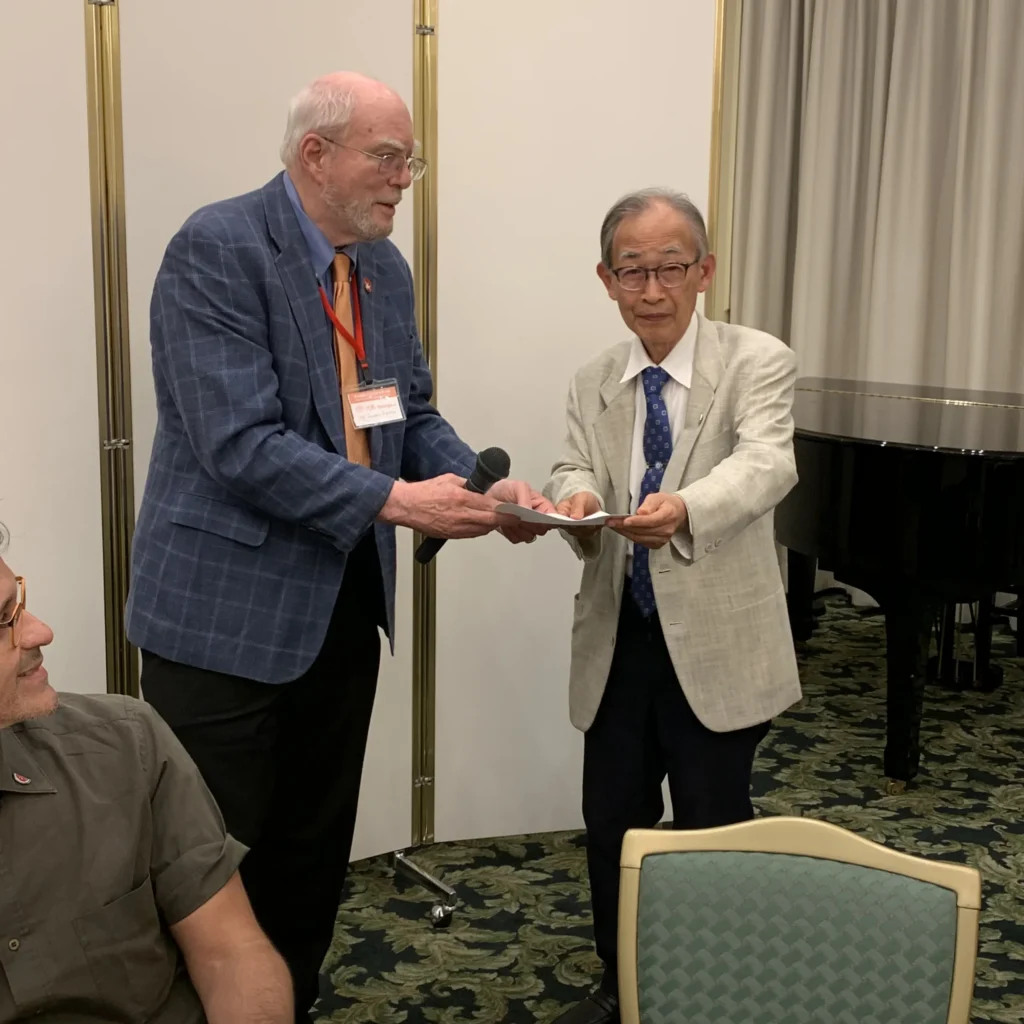
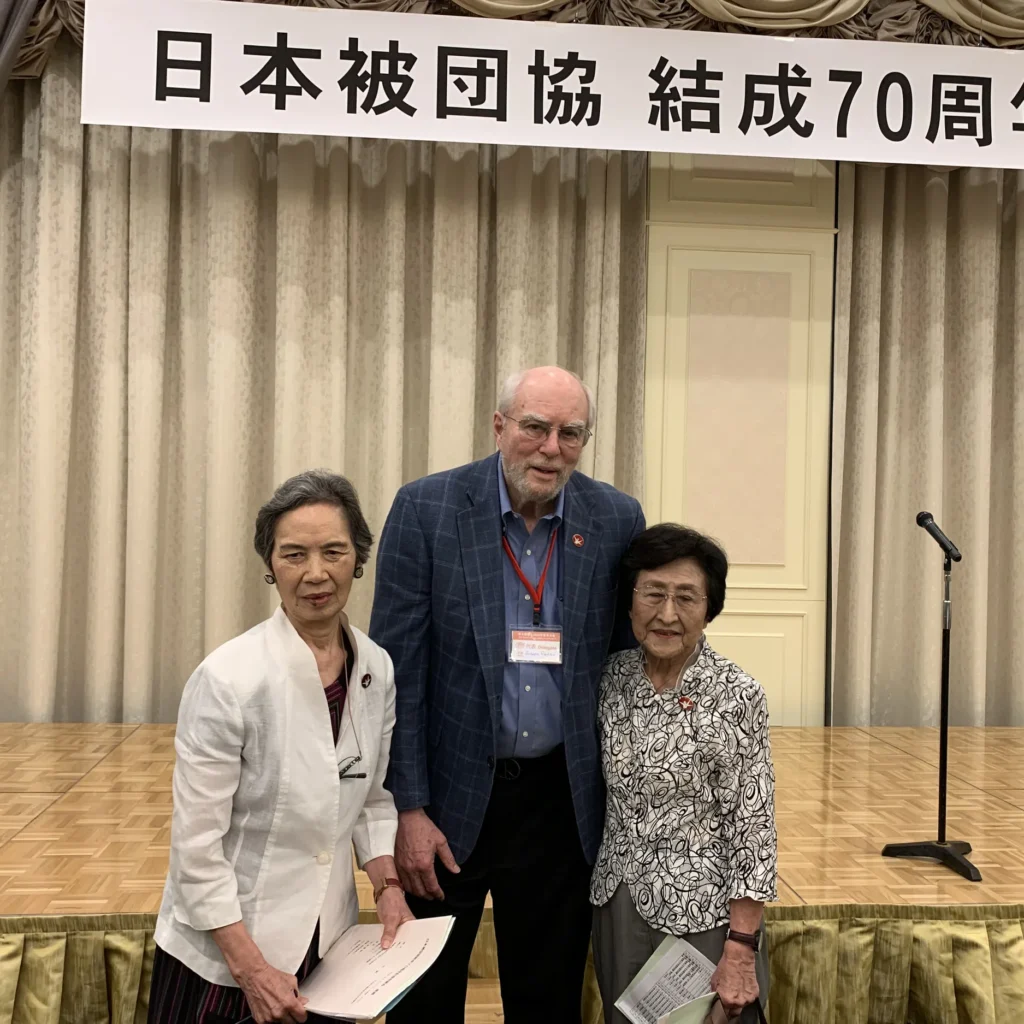
- Presenting September 11 Families for Peaceful Tomorrow’s greeting on the occasion of Nihon Hidankyo (Japan Confederation of A- & H- Bomb Sufferers’ Organizations) 70th anniversary celebration
- Participating in the International Conference’s Hiroshima Declaration drafting committee
- Nurturing younger U.S. and other international participants
- Networking with Japanese and other disarmament and peace movements
- Simply being present
MAJOR TAKEAWAYS:
Programmatic:
- Facilitating planning for U.S. and IPB dimensions of an “Empty Chair” campaign during the TPNW Review Conference. (Initiated by Movement de la Paix in France, and with my advocacy adopted by the Gensuikyo and IPB, it will seek to raise awareness about the TPNW with “empty chair” rallies, the empty chairs symbolizing the absence of the nuclear weapons states from the TPNW. I have begun follow up with New York Peace Action and other New York based organizations.
- Deepened connections with leading movement figures internationally
- Analytical knowledge to serve Common Security and U.S.-China report, articles, and talks
- Possibility of hosting Yuhi Shimada for 3-4 months while he works to improve his spoken English. Yuhi is relatively young, very capable, and with considerable organizing experience. He will likely be Gensuikyo’s next international secretary.
Analytical
- In addition to Japanese activists and movement leaders, we were 70 internationals from 70 countries. This included 4 South Korean Hibakusha and about 40 delegates from labor unions, medical associations, and national peace and justice movements. There were unusually few from Europe and the U.S., which I think reflects the state of our movements. (We were 4 US Americans: Batya Yelloz of PANYS, Dylan Grentzinger a student in Nagoya and member of DSA’s international committee, and Ira Helfand via video from Back from the Brink)
- With US power in decline, there are rising military tensions across the Indo-Pacific region.
- The unhappy confirmation that US and other nuclear weapons states’ continuing disregard for the NPT. The failure of the NPT Review Conference, and the Trump/Netanyahu war on Iran are fueling pressures in the Asia-Pacific, Europe, and Southwest Asia for nuclear weapons proliferation
- A deepened understanding of the vital role that physically and emotionally traumatized but courageous Hibakusha have played in creating and maintaining the nuclear taboo, remorse that as we lose them due to age and illnesses that a critical foundation of our movements will be lost, and an appreciation of second and third generation Hibakusha’s efforts to carry on. (Note that Ohmura Yoshimuri, who we toured in May, is now the Secretary General of the second generation hibakusha organization.)
- Support for the TPNW remains the primary actional demand of our movement. Although I will not be able to join the TPNW Review Conference at the end of November, I played a significant role in having the Conference and later the IPB commit to supporting a French call for an “empty chair” (nuclear weapons states) international campaign when the Review Conference begins.
- Repeated references to our brief May Hibakusha tour, and especially to the session at Holy Cross University encouraged Hibakusha and the wider Japanese movement and led to serious discussions about Peace Action New York State hosting Hibakusha and other international delegates who came to the TPNW Review Conference.
- It is more likely that Japan will soon opt to become a nuclear weapons state. With encouragement from the US, with the Takaichi government pressing a review of the country’s three non-nuclear principles and defense minister Koizumi calling for the need to end the taboo on discussing the possibility of Japan creating its own nuclear arsenal. Most likely Japan will approve the reintroduction of US nuclear weapons to Japan, primarily in relation to China, but also North Korea.
- Within Japan, demonstrations urging protection of the peace constitution are understandably a primary focus of their movement, as is winning the reelection of Okinawa’ anti-bases governor Denny Tamaki
- The South Korean international tribunal on the mass murder of Koreans with the Hiroshima and Nagasaki A-bombings is now scheduled to take place in Seoul, not in New York on the eve of the TPNW Review Conference. (Note, I was initially asked to serve as the anchor for the tribunal in New York, but with doubts about their stringency, which included launching a case in the US courts which I thought would go nowhere, they have revised their strategy, which will include challenging deterrence theory.)
- For the first time, the International Conference’s Hiroshima Declaration referenced the related dangers of artificial intelligence.
- Both Korean and Japanese speakers emphasized that a lesson from the Iran War is that any nation that hosts US military bases has become a target for enemy attacks.
August 3
International Conference – Opening Session
- My friend Emiko Hirano of the New Japan Women’s Association opened the conference by introducing the international participants and referencing greetings from Vietnam’s president, the mayors of Hiroshima and Nagasaki, numerous Japanese elected officials, and the Japanese Communist Party
- Noguchi Kunikasu, a Hiroshima Hibakusha and Conference Steering Committee Co-Chair set the stage for the conference with an opening talk. After welcoming participants, he referenced Hidankyo’s 70th anniversary; the decreasing number of surviving Hibakusha; the Takaichi government’s “massive military buildup,” its review of the country’s Three Non-Nuclear Principles,” development of the “capability to strike enemy bases”, and the militarization of academia, the Russian invasion of Ukraine, Israel’s “destruction and massacre” in Gaza, the US attack on Venezuela and attacks on Iran. He condemned the continuing use of the “threat of nuclear blackmail” and the trampling of the U.N. Charter order. He reviewed the sizes of the nuclear powers’ nuclear arsenals, made (what I thought to be an inappropriate) reference to a silver lining in the NPT Review Conference of 70% of nations at the NPT Review conference urging nuclear powers to “take action toward nuclear disarmament.” He closed with an appeal to eliminate dependence on nuclear threats and deterrence, for an international order based on the UN charter, and to campaign for Japan’ joining the TPNW and diplomacy based on the peace constitution
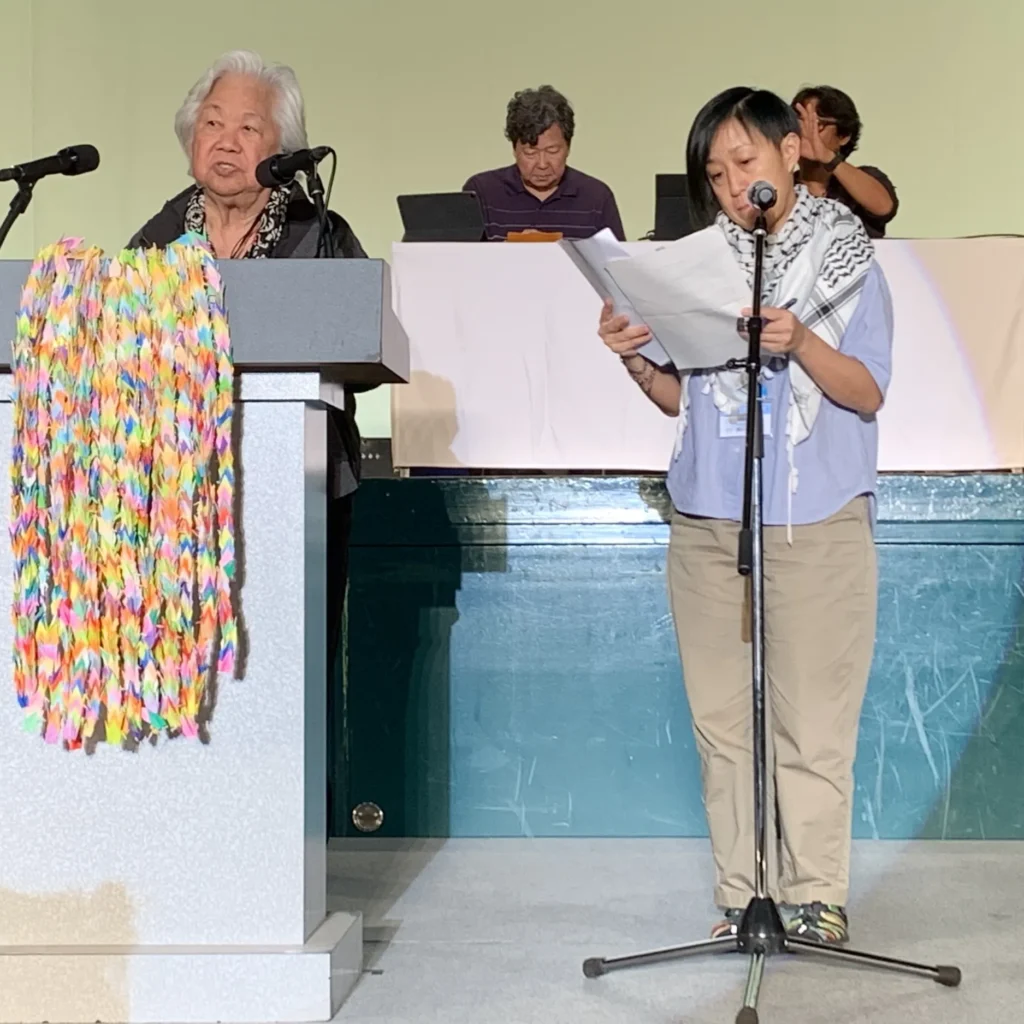
- Noguchi-san’s speech was followed by two Hibakusha, Kodama Michicko who I have known and admired for many years and Yokoyama Teruko. (I’d be glad to share their text with those who are interested.) Each has a searing story, with deaths of loved ones from the A-bombings compounding their emotional suffering and challenges over the years. Kodama-somehow had managed to pull life affirming energy out of it all and is the Assistant General Secretary of Hidankyo. Yokoyama on the other hand, after recounting the stories of Hibakusha – including her parents and siblings – who either died or understandably gave up on life concluded that she is “overwhelmed with sorrow, regret, and deep anger toward the war and the atomic bombing.”
International Conference – First Session
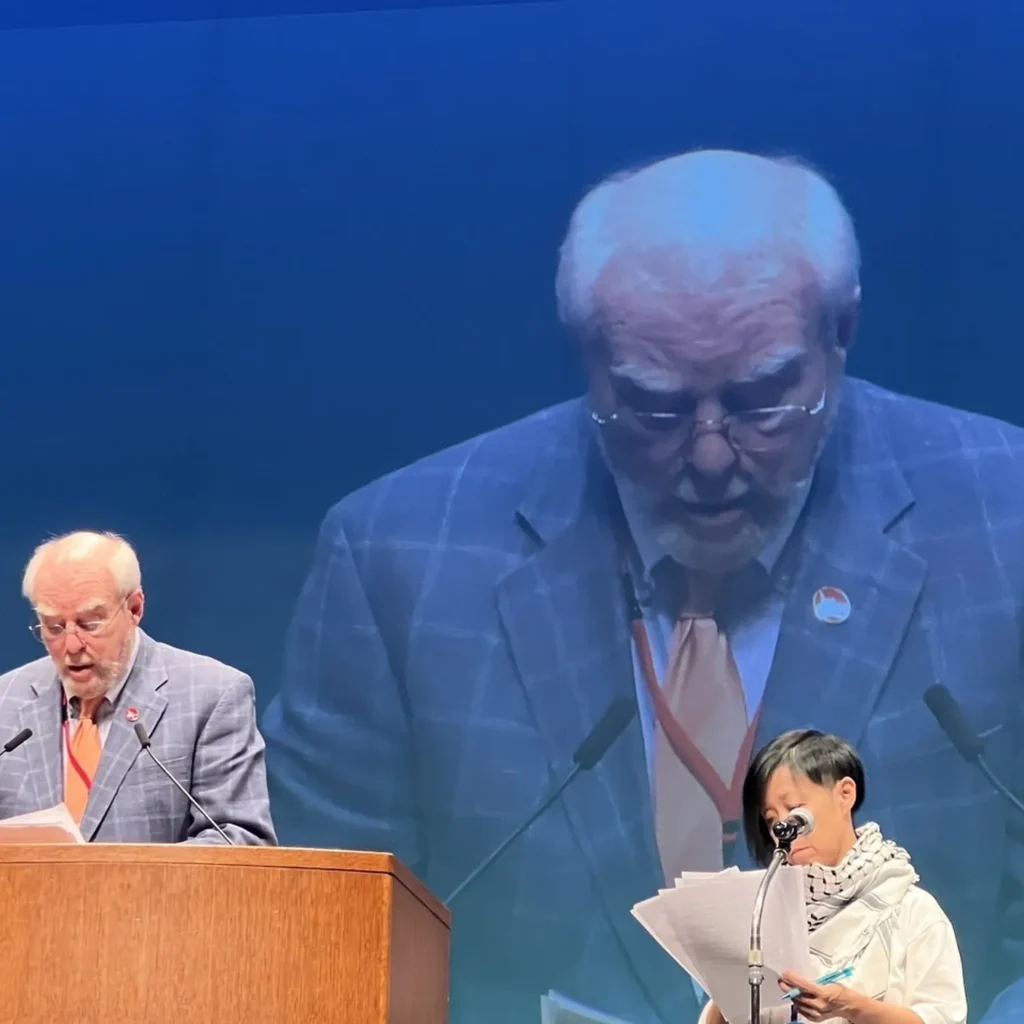
- It began with my keynote speech. A copy is attached.
- Sophie Bolt, of CND in Britain addressed the conference via video. She decried the loss of arms control agreements, most recently New START. stressed the UK government’s commitments to expanding its nuclear arsenal, building new Trident submarines, and purchase nuclear-capable fighter planes from the U.S. with its massive increases in military spending coming at the cost of essential human services, the deployment of new U.S. nuclear weapons in Britain, and protests being held at Lakenheath, where the U.S. nuclear weapons are based. She referenced a massive European-wide anti-war summit in London which included parliamentarians and thousands of activists. She also referenced street protests and calls for an end to Britain’s complicity in the Gaza genocide. She closed by saying “actions of our government…being used by other countries, like Japan, to consider dropping their own opposition to nuclear weapons.”
- Dr. Carlos Umana, a Costa Rican, formerly vice-president of IPPNW, who is now organizing for the TPNW in Spain, leading Desarme Nuclear, the Spanish Alliance for Nuclear Disarmament, a coalition of 65 organizations. He stressed that we must prevent what we cannot cure: nuclear war, and he reviewed the current patterns of aggression by nuclear armed states and the erosion of international law. He referenced the history of Pax Atomica, noted that indigenous people have been the victims of nuclear weapons testing, and questioned the rationality of leaders in calling out the leader who recently “threatened the destruction of an entire nation. Although Spanish Prime Minister (who Carlos described in later conversation as living on borrowed political time and not yet ready to sign onto the TPNW) who has condemned “a system that requires zero mistake and constant correction to avoid total destruction is not a guarantee. It is a gamble.” Carlos stressed the importance of the TPNW as the way forward, and he is leading organizing in Spain to create the base needed to eventually win Spain as the first NATO member to break ranks and sign the TPNW. I later had a number of conversations with Carlos who is now a friend and colleague.
- Lee Jun Kyu is a South Korean researcher and has served as the primary bridge between the Japanese and South Korean peace and disarmament movements. This was among the best of his speeches over the years. Like me, he referenced Gramsci’s reference to an interregnum as the post-World War II order is being fundamentally shaken. He noted that US-Chinese competition has become the “central axis of international politics,” that “great power politics are coming into sharp relief,” with the US, Russia, and Israel leading the way with their nuclear threats. He referenced Russia’s “war economy”, the strengthening of NATO unity as a result of the invasion of Ukraine, and the growing confrontation between Russia and the West. He observed that “in the Asia-Pacific region, frameworks for alliances and military cooperation are being realigned, centered on the U.S.-China competition” He referenced AI, mineral, and energy competition, and bemoaned that “war and armed conflict have become commonplace. “Jun-kyu referenced Yoon Suk-yeol’s failed coup and called out Trump and Putin for their assaults on democracy which is needed to place ‘the life and dignity of every single human being at the center of security.”
Lee focused on the “nuclear standoff in East Asia and on the Korean Peninsula [which] is becoming increasingly acute…North Korea has adopted a national policy centered on ‘frontline breakthrough’ and ‘self-reliance’ focusing on economic development and strengthening national defense.” It has restored its alliance with Russia and is improving relations with China. In 2022 the DPRK “formalized its nuclear first-strike doctrine. “At the same time, it has defined inter-Korean relations…as a relationship between ‘two hostile states’ denying shared ethnic identity…and abandoning its reunification policy…it is superimposing ‘block confrontation’ onto the nuclear standoff and the division of the peninsulas.” At the same time, the direction of US-ROK policies is to “integrate and operate US nuclear capabilities with South Korea’s conventional and advanced technological capabilities” as it increases its military budget, while the US-Japan alliance is focused on containing China with the militaries of both countries…conducting war simulations that assume the ‘use of nuclear weapons.’” The way forward he argued is to address the issue of joint US-ROK military exercises and press to transform Korea into a nuclear weapons-free zone.
Yasui Masakazu, Gensuikyo’s general secretary, rounded out the session, hammering home Gensuikyo’s priorities for its leading members and for the rest of us. Russia and the US are trampling on the UN Charter and pursuing “rule by force.” The TPNW has (he claimed) momentum and provides a vision in this time of crisis. Despite the lack of a final declaration the NPT Review demonstrated “the global trend toward prohibiting and eliminating the use and threat of nuclear weapons.” Gensuiky’s 95-member delegation to the NPT Review strengthened solidarity with US movements opposed to Trump’s authoritarian rule. The Gensuikyo/Hidankyo speaking tours in the U.S., France and Spain helped to build opposition to nuclear weapons and for the TPNW. The Japanese government has opposed the TPNW and seeks to revise the Three Non-Nuclear Principles to allow the US to bring nuclear weapons into Japan. “756 local Japanese governments, representing 42% of all local governments” have urged the Japanese government to sign and ratify the TPNW. A priority for Gensuikyo is continuing to develop cooperation with [South] Korean partners for a nuclear free and peaceful East Asia.
Prior to the Q & A Session, there were two “Related Speeches”
Sean Conner, IPB’s Executive Director, spoke via Zoom. The first part of his speech addressed the fears of nuclear attack that are being driven by political narratives and propaganda, and which are fueling new arms races. He then described IPB’s common security diplomacy advocacy and the imperative to reduce global military spending.
Ryu Mi-Kyung is International Director of the Korean Confederation of Trade Unions. He spoke about responding to Zenroren’s proposal that they hold 80th anniversary commemorations last year, which they did. (Zenroren is a major Japanese trade union confederation and an important affiliate of Gensuikyo.) Lessons from those activities, he said, underlined the importance of grassroot movements, especially the Hibakusha and the role of trade unions. He referenced a KCTU joint testimony meeting of Korean and Japanese A-bomb survivors last fall, and the importance of the struggles of Korean and Japanese A-bomb survivors being one. (Worth noting is that some Koreans resent Korean A-bomb survivors being referred to as Hibakusha, which is a Japanese word.) He decried far-right South Korean forces who are calling for ROK nuclear weapons and US-Japan-ROK military cooperations which threaten to transform the Korean Peninsula and East Asia into a confrontation between hostile military blocs.
Roland Nivet is a leading figure and spokesman for Mouvement de la Pai in France. He spoke via Zoom from France in a predictable rally speech. He covered many of the points made by others and called for support for a petition campaign that he has initiated and called for a series of actions over the coming year. During the conference I learned that some of the younger figures in MVP hope to assume greater leadership roles in the organization.
Joseph Essertier is an American scholar who teaches Japanese literature in Nagoya and leads a World Beyond War chapter in Japan. I’ve met him before but got to know him much better this time around. His talk focused on the organizing for the People’s Tribunal which will increase popular understanding of the impacts of the A-bombings on Koreans in Hiroshima and Nagasaki, many of whom were forced laborers conscripted from Japanese colonial ruled Korea. “By establishing the illegality of the US atomic bombings through this tribunal, we plan to make it easier for people to condemn all nuclear threats and the use of nuclear weapons as illegal.” The tribunal will also challenge deterrence theory. Joseph reminded conference participants that most of the US military leaders in 1945 called the a-bombings “militarily unnecessary, morally reprehensible, or both.” He referenced the South Korean Candlelight Revolution, the nonviolent movement for democracy and peace, which has been inspired similar Japanese demonstrations and rallies recently. Among others, Joseph also citied Howard Zinn and his critique of the “fundamentally decent people” who in 1945 killed a quarter of a million people to make a point.
International Conference – Second Session
Dr. Ira Helfand of IPPNW, PSR, and Back from the Brink joined the conference via pre-recorded video. To my mind, Ira is among the most cogent speakers and organizers in our movement, and he did not disappoint. In recent years I have introduced BFB as the leading edge of US disarmament and abolition campaigning, about which Gensuikyo has been very interested. Describing our crisis, he began by explaining that US policy is based on the dangerous myth that nuclear weapons make us safe. Believing that the US will not disarm unilaterally, BFB focuses on the steps needed for the US to join the TPNW in the future: abandoning the first use doctrine, taking US nuclear weapons off hair trigger altert, eliminating the possibility of the president launching a nuclear weapon on his own authority, and opposing the $1.7 trillion “modernization” capability increases. More than 70 cities and towns – including major cities – have endorsed BFB. As have more than 500 NGOs and (now six) state legislatures. The campaign has three primary messages: nuclear war can really happen, nuclear war if it happens will be more catastrophic than we can imagine (with the average US nuke 50-60 times more powerful than the Hiroshima A-bomb), and that this doesn’t need to happen.
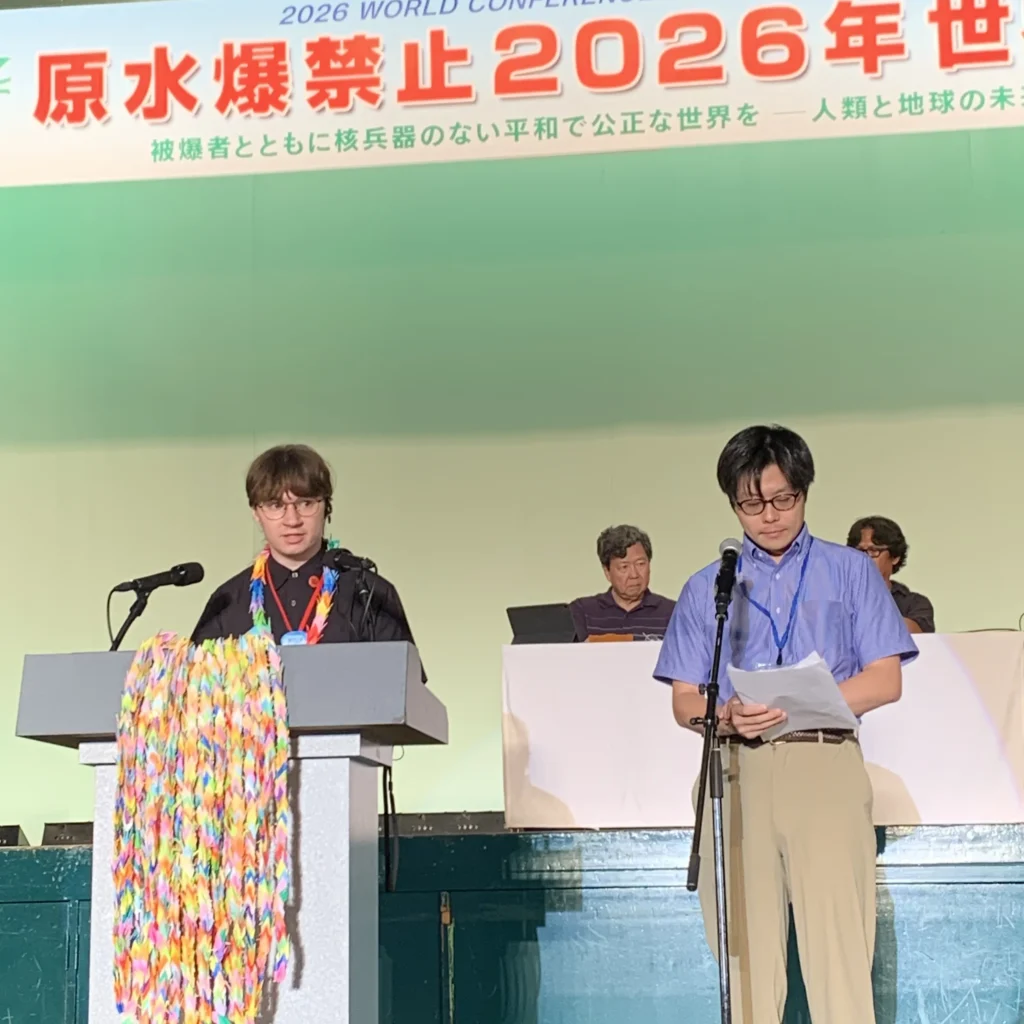
Batya Yelloz represented Peace Action New York State and is a student organizer at CUNY Macaulay Honors College. She confessed to being new to the movement and described how she and friends revived the dormant PANYS chapter at her college. Their focus has been training st to respond to ICE and the Gaza genocide. In the course of the conference, she took inspiration from our CPDCS Hibakusha event at Holy Cross University and began putting arrangements to host Hibakusha when they come to New York for the TPNW Review Conference in late November.
Dylan Grentzinger represented Democratic Socialists of America’s International Committee. This, obviously, was an unusually heavily US peopled panel, clearly a strategic choice by Gensuikyo’s leaders. Dylan is a business studies student at a Japanese university, and in private conversation with me, he said that he was not a radical when he came to Japan, but that business school had made him one! For someone so young and recently engaged with DSA, his knowledge and speeches were unexpectedly impressive. He stressed that DSA and its victories have not been limited to Zohran Momdani, and he cited a number of other victories and twelve DSA Congressional candidates. Dylan critiqued the Democratic Party and the US empire and stressed that DSA focuses on the needs of workers, healthcare, public housing, an end to police violence, and understands that peace requires, but cannot be limited to, nuclear disarmament. Gensuikyo and the JCP are clearly inspired by DSA and its victories. Leaders of their delegations to the NPT Review met with Mamdami and some of his staff.
Duong Thi Nga is Vice Secretary General of the Viet Nam Peace Committee, which is ostensibly an NGO but is an expression of Viet Nam’s government. Gensuikyo and the Peace Committee have collaborated for decades, and every Gensuikyo Hiroshima Declaration expresses the need for solidarity with the victims of Agent Orange, the deadly defoliant used widely against the forests and people of Viet Nam. In honoring that relationship, Thi Nga was made a co-chair of the International Meeting. Her speech named this “historical period marked by profound volatility and uncertainty.” In the Asia-Pacific, the period is marked by “fierce strategic competition among major powers.” [Recall that among the most profound mistakes of the “best and brightest of the 1960s was ignoring 900 years of Vietnamese resistance to Chinese encroachments and unwanted influence.] Thi Nga stressed the importance of the Non-Aligned Movement and its core philosophy which calls for respect for independence, sovereignty, territorial integrity, non-interference in internal affairs, non-participation in confrontational military alliances, and peaceful coexistence. She urged reaffirmation of the supremacy of international law, the UN Charter, and the “irreplaceable role of nuclear prohibition treaties. She talked about the importance of people-to-people diplomacy and the promotion of peace education. She also gave me a recent autobiography of Madam Binh, the NLF’s lead representative in the Paris Peace negotiations for five years and who is just turning 100. I shared a story with her about Madam Binh addressing a Clergy and Laity Concerned About Vietnam conference in Ann Arbor, if I remember correctly, it took place in 1971, from Paris and long before the Internet. She responded that they are preparing a second book comprised of memories and messages from people who have worked with her over the years, she and asked for any help I can provide in this project.
Toguchi Osamu, a JCP member of the Okinawa Prefectural Assembly. I wrote about the abuse of Okinawa in my book The Sun Never Sets… Okinawa has long been abused by both the Tokyo and US governments. From the Japanese side, facing inevitable defeat, the battle was fought to “buy time for the emperor system.” Over 200,000 of its people were killed in the 1945 Battle for Okinawa – including civilian suicides demanded by the Japanese military. That was one quarter of Okinawa’s citizens. Survivors were then confined to concentration camps, as the U.S. seized many homes and property to augment and create new military bases for the U.S. Roughly 70% of the 130 US military bases and installations are concentrated in Okinawa to keep them away from the rest of the country. For a period of time, and secretly, the US based nuclear weapons in Okinawa. With so many US bases, Okinawans have been tormented by military crimes, rapes, and sexual violence, the terrorizing sound blasts of low altitude and night landing exercises, military accidents (like the helicopter that fell into a university) and live fire exercises that sometimes destroy people’s homes and properties. More recently, as the Japanese military – “self-defense forces” – prepare for possible war with China, it is building new bases and has deployed missiles and troops to Okinawa and to some of its more remote islands, which may require the relocation of 120,000 Okinawans.
Toguchi-san reviewed this history and the history of Okinawan resistance to the bases and exploitation by the central government. He described the 1995 nonviolent uprising and the resulting commitment to abandon the Futenma air bases, possibly the world’s most dangerous one, with plans to build a new base in northern Okinawa. The government has since abandoned its Futenma commitment, and the Jello-like seabed where the new base is to be built and massive Okinawan opposition to its construction may mean that the new base may never be built. With the review of Japan’s Three Non-Nuclear Principles, Okinawa now faces the prospect of the reintroduction of US nuclear weapons to the province. Critical to the resistance is the reelection of anti-bases Governor Denny Tamaki. Toguchi-san appealed for support for “Denny” in this fall’s election.
August 4
Specials Session focused on the reality and damage caused by the A-bombings
- Lee Kiyeol is the former vice president of the Korean Atomic Bomb Victims Association. His tragic personal story brought to mind Odysseus’ tragic Odyssey. He was an infant, one of 100,000 Koreans in Hiroshima and Nagasaki at the time of the A-bombing. He has needed many surgeries and still cannot sleep at night. He went on to explain that he is a survivor of three wars: the A-bombings, the Korean War shortly after he returned to Korea, and in his early twenties he was sent as a Korean soldier to the Vietnam War. Such a complex and tragic life. He now lives in Hapcheon in South Korea, where perhaps as many of 70% of Korean A-bomb survivors live. His appeal was for an end to war, for the elimination of nuclear weapons, and for an end to the nuclear threats on the Korean Peninsula.
- Benetick Kabua Maddison is Executive Director of the Marshallese Educational Initiative. His talk was compelling and opened new ground, the demand for the release of 80 million documents related to the impacts of the 67 U.S. nuclear weapons tests in the Marshall Islands. Over the past 70 years Gensuikyo has maintained strong ties with Marshallese survivors of the Bikini H-bomb test and their descendants. I have now worked with three generations of them. As Benetick explained, the 1954 Bikini H-bomb was 50 times more powerful than the Hiroshima A-bomb. Fallout, which came in the form of flakes mistakenly thought to be snow which people there had never seen, irradiated and killed most of the Bikini Atoll islanders. Japanese fishermen were also poisoned and later died, and Japan’s food supply was also poisoned. This led to a petition drive signed by 32 million Japanese, which in turn led to the first World Conference against A- & A- Bombs and the creation of the Japanese peace and nuclear weapons abolition movement.
After describing the white powder that fell on Bikini Islanders who had been removed before the test to Enewetak Atoll, he began by describing the leaking tomb into which 111,000 cubic yards of radioactive soil and debris which is pushed closer to leaking with every storm as the seas rise. He then described the ways that “our bodies are the living archives of the nuclear age”, with the jellyfish babies (translucent skin and no skeletons) born immediately following the “test” and the thyroid and leukemia cancers and other birth defects which have devastated “survivors.” Some compensation is received via the Compact of Free Association with the US, but it covers only a fraction of health care costs, and it functions as a political trap. While many in the Marshall Islands want the release of the 80 million sequestered documents and for their nation to sign the TPNW, there is fear that the U.S. response will be to cease the compensation payments.
Benetick concluded with their demands for comprehensive Justice: fully funded healthcare for all affected communities, genuine environmental cleanup not a cracking concrete tomb, the right of return of all displaced people, and the release of the 80 million documents.
Kim Jinyoung spoke for the South Korean People’s Solidarity for Social Progress. She provided additional information about the Korean A-bomb survivors and their commitment to spreading understanding that “nuclear weapons and humanity cannot coexist.” Her talk included a condemnation of the Lee Jae-myung government security approval from the US to build nuclear powered submarines, while also condemning North Korea’s nuclear arsenal. She spoke about the A-bomb museum in Hapcheon City, where it is written “The war is over. For the A-bomb survivors it is not yet over.” and she described the anniversary demonstrations taking place there. She, and later other members of her delegation, talked about events held across South Korea to memorialize Mr. Kim Hyeong-ryul, a second-generation A-bomb survivor who suffered throughout his childhood, and was the first Korean A-bomb second generation survivor to reveal is identify. He launched an anti-nuclear peace movement, and died 21 years ago at the age of 34. She reported that about 3,500 people have officially joined second-and third-generation survivor organizations, which are pressing for nuclear weapons abolition and for the rights of second-generation survivors.
Hiroshima Declaration: The special session closed with the adoption of the Hiroshima Declaration, which is attached. It will serve as the foundation for the activities of Gensuikyo’s affiliates across the country and for its central office, as well as a source of inspiration for nuclear disarmament movements internationally. I posted it to our elist and was later informed that as a result it was quoted during a civil disobedience demonstration on August 6 at the Lawrence Livermore Lab in California.
August 5 – Workshops
Government & Civil Society
Following the International Conference, this day was devoted to 15 workshops for the thousands of activists who came to the World Conference. They ranged from the Dialog between governments and civil society and the achieving a nuclear free and peaceful Japan and Asia to signing the TPNW, protecting article 9 of the Japanese constitution, learning from the Hibakusha and their struggles, a youth forum, the climate crisis and renewable energy instead of nuclear power, and more.
Anton Wein-Wislocki, Counselor/Head of Austrian Foreign Ministry Nuclear Weapons Department. He is a successor of Alexander Kmentt, formerly Austria’s Disarmament Ambassador, referred to as the grandfather of the TPNW, who played a leading role in the conferences and negotiations that led to negotiation of the treaty. Kmentt is now Austria’s ambassador to the UN in Geneva. Mr. Wein-Wislocki’s points included: the ‘TPNW “owes a direct debt to the advocacy of Hibakusha on the international state.” The incomparable difference between nuclear and conventional weapons and the devastation nuclear weapons can inflict. The risk of a new arms race is higher than ever and cited the Bulletin of Atomic Scientists 85 seconds to midnight and UN Secretary General Guterres’ warnings. The security needs of non-nuclear states are not being taken seriously and reliance on nuclear deterrence increases the dangers of escalation, miscalculation and accidents. 100 states have signed and/or ratified the TPNW. “Only the abolition of nuclear weapons, verified and complete, can reduce existential risks for all of us. Civil society and scientists are playing essential roles for nuclear weapons abolition and security.”
Enrique Javier Ochoa Martinez is Undersecretary for Multilateral Affairs and Human Rights of the Mexican Foreign Ministry. He came to the packed workshop (200 or so people) directly from his exhausting travel from Mexico to Tokyo and then to Hiroshima. His speech was thoughtful and made the following points: Hibakusha testimonies have helped to shape Mexico’s policies; A nuclear war now would be devastating and would take what and who survives decades to recover. Global military spending is now $2.89 trillion, 15 times development aid; Mexican President Sheinbaum has called for 1% of military spending to be devoted to reforestation; We face the danger of renewed nuclear weapons testing, despite the importance of the Comprehensive Test Ban Treaty. Nuclear threats are no longer taboo and AI and other advanced technologies increase nuclear dangers. Human control must be maintained. We face three existential threats: nuclear weapons, the climate, and AI. Nuclear weapons violate international humanitarian law. He stressed the 60th anniversary of the Tlatelolco nuclear weapons free zone treaty for Latin America and the importance of the International Court of Justice mediating conflicts.
Carlos Unma, Yayoi Tsuchida, and I each gave slightly modified versions of our International Meeting speeches. I had a one-on-one exchange with Mr. Ochoa Martinez about the ICE kidnappings and deportations and their impacts on my family. He shook his head in despair and resignation.
Asia-Pacific Militarization
Kim Jinyoung – spoke about military tensions and efforts to integrate AI. In ROK strong opinions for nuclear weapons and militarization. ROK gets benefits from NPT and UN Charter. 100 countries signed TPNW – shows that it is the real path. Banner with two slogans. More than 100,000 Koreans were exposed to H & N radiation. Summit with Trump – agreed on development of ROK nuclear powered submarines. DPRK has 60 nuclear weapons with announced plans to increase their nuclear capability. ROK nuclear weapons victims and civil society won’t accept this. She described several days of A-bomb rooted Hapchung rallies, and they want Hapchung declared as nuclear free city. She explained that, 2nd generation Korean A-bomb survivors have not received official recognition, and that for them the war never ended. Many 2nd & 3rd generation Korean A-bomb victims are not aware that they are hibakusha.
Duong Thi Nha
Focus on Vietnam head of state message to the conference. Multi-dimensional crisis – see her speech text) Agrees with me about the dangers of proliferation. Also, economic and social media/information/AI struggle for power. There is hope. Rules of past 80 years are being re-written. That presents opportunity for people to impact the rules. World Conf. is also a source of hope, TPNW RevCon an opportunity to impact the rules. Nonaligned Nations’s commitments are important, calling for non-interferences, not to join military alliances. She stressed the importance of people-to-people relations. She cited Ho Chi Minh, saying that Vietnam’s strength has been recognizing the importance of international solidarity, which leads to peace.
Kawata-san (Japan Communist Party)
Focus on Northeast Asia – need for a Northeast Asia Nuclear Weapons Free Zone. He shared a map of the world’s NWFZs that have been created by nuclear weapons and umbrella free nations. Japan and Rok gov’ts must get out of US nuclear umbrella. We must work for abolition in Russia, China, and DPRK. This can only be done in context of worldwide abolition. US-Japan-ROK vs. China-North Korea the emerging bloc system. Need to defend the 3 non-nuclear principles declared in 1971. 1976 Diet decision of 3 non-nuke principles as Japan joined NPT. That showed the will of national Diet, but it wasn’t law. It has heavy meaning, but the Cabinet is trying to revise this resolution. What happens to us if the US can freely bring nukes into Japan. Look at Iran war, countries hosting US military bases can be attacked by country fighting the US. 130 US military installations across Japan The US could freely bring nuclear armed ships into commercial ports. If 3 non-nuke principles are revised, US can bring them in freely. 76% support non-nuke principles, only 51% support Takaichi gov’t. Nuclear deterrence is not 100% efficient. Risks of failure. Hibakusha talk about the reality of the use of nuclear weapons.
Joseph Gerson. I began with the1890s seizure of the colonized steppingstones to the holy grail of capitalism – China Market and referenced the history of US bringing nukes into Japan which was revealed by Niihara-san when he found documents at the JFK Library. I stressed the Prime Minister Takaichi is now more in U.S. pocket than ever with the US spending billions to prop up the value of the yen. I noted the end of U.S. global hegemony and the question whether a G-2 US-China or mufti-polar order will follow. After intensity of Biden era Trump and Xi agreed to “competitive coexistence” The competition proceeds on six inter-related levels: Military. Economic, Scientific/intellectual, Political. Social and Spiritual.
Concentrating on the military dimension, I reported that the US a nation has been almost constantly at war since 1941, noting the influence of military-industrial-technology-Congressional Complex, Despite Trump disparaging alliances he has been holding tight to Japan, ROK, and Philippines, & Australia. The massive RIMPAC naval show of force was a display of US military commitments and capabilities. However, the Chinese navy larger than Washington’s and increasingly has area denial capabilities. U.S. aircraft carriers, destroyers, and bases are vulnerable. The U.S. is spending $1.7 trillion for its nuclear modernization/upgrade, while China seeks parity. NATO 3.0 represents the following through on Obana’s pivot to Asia. Taiwan remans the most dangerous possible flashpoint, with Trump sending mixed messages about U.S. commitments. China wants peaceful reunification, following its traditional doctrine of winning without fighting, but miscalculations and incidents could trigger a catastrophic war. I went less deeply into the economic competition, with references to Trump’s tariffs, the roles of rare earths, China’s Belt and Road system, and more.
HIROSHIMA AND NAGASAKI RALLIES
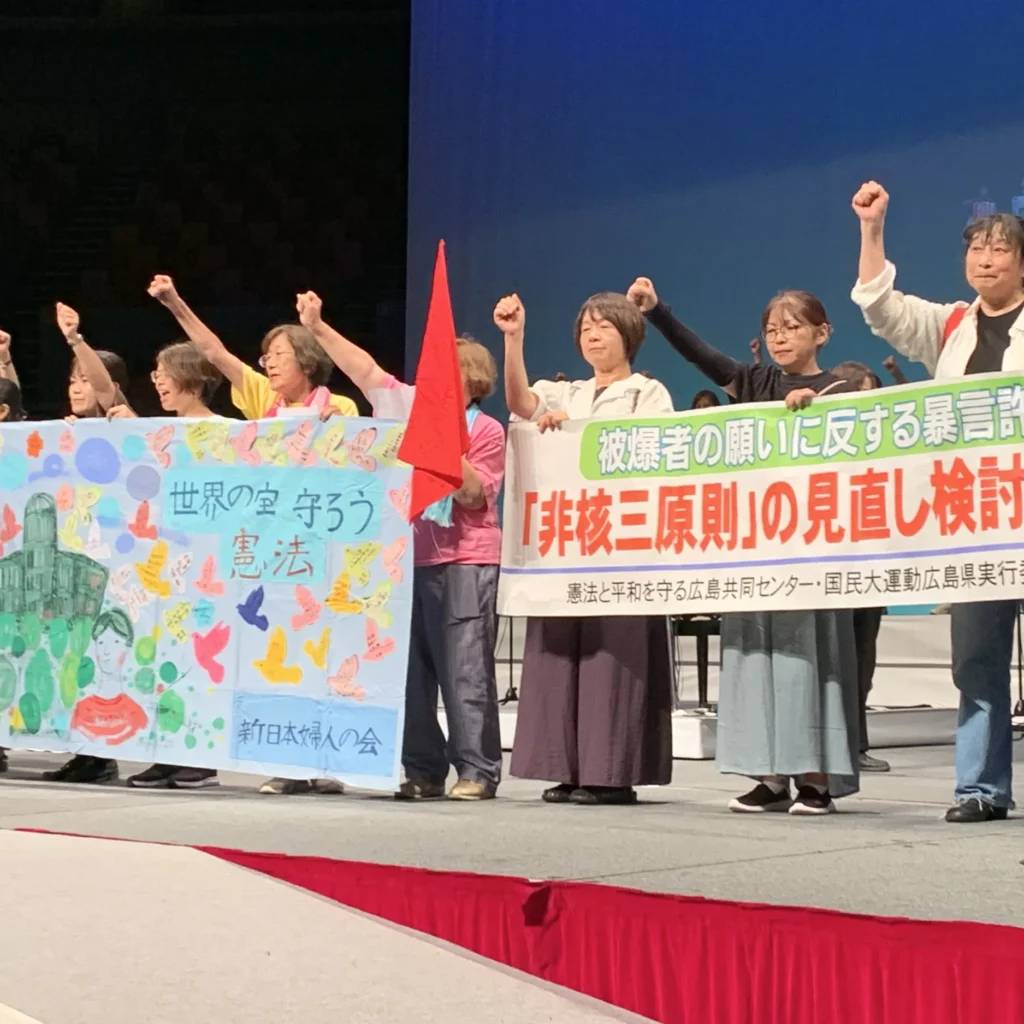
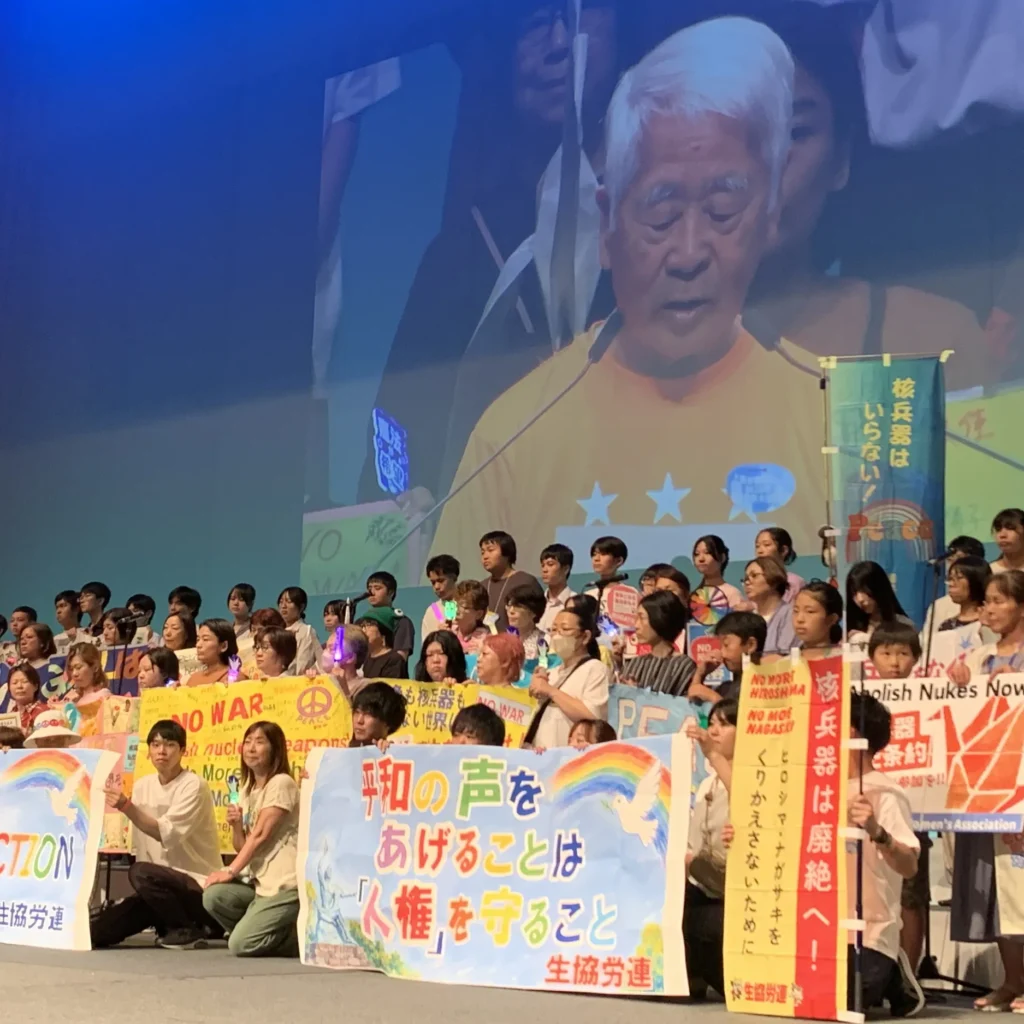
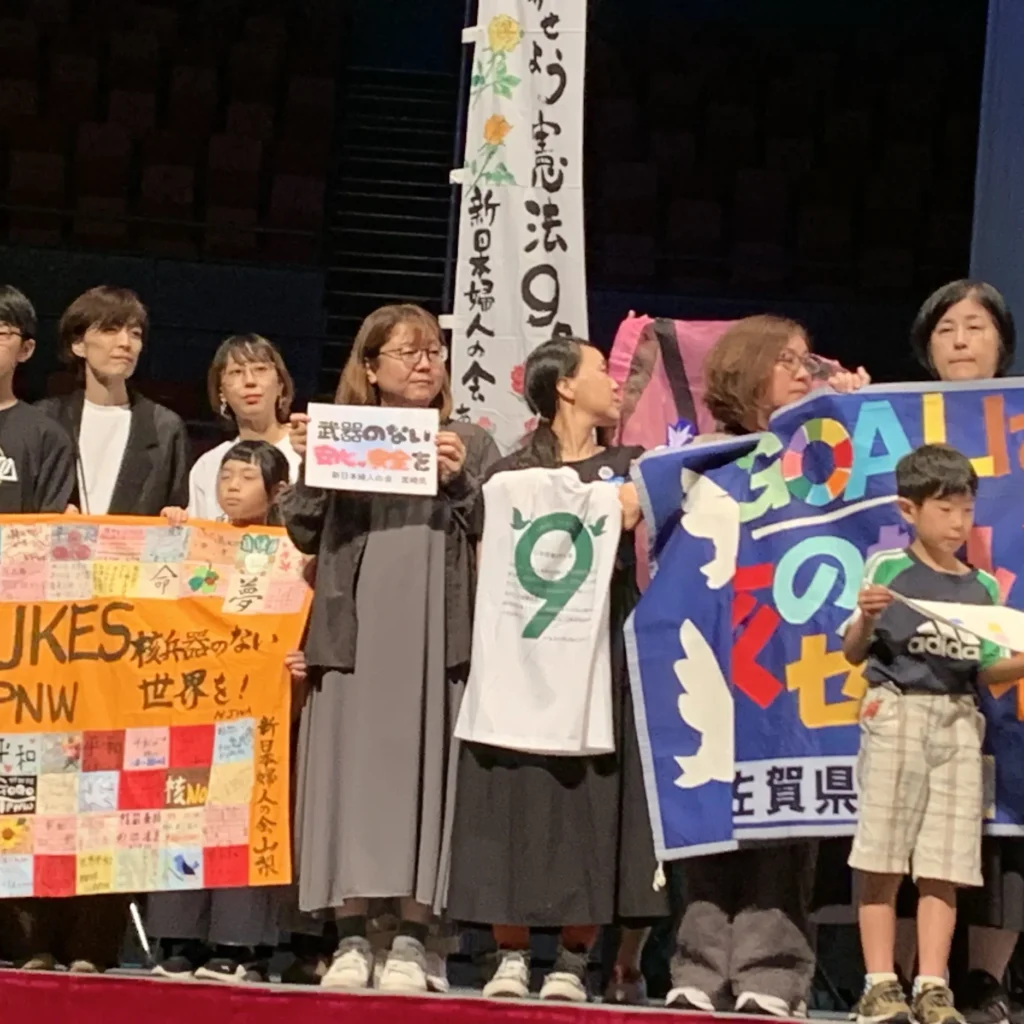
On August 4, 6, and 9 rallies brought together roughly 5,000 community based and organizational (women’s, labor, etc.) activists from across Japan, from Okinawa to Hokkaido, were held in Hiroshima and Nagasaki. They are designed to inform and inspire Gensuikyo activists and other interested participants. They provide an important platform for Hibakusha to give their testimonies and to teach new generations of activists about the A-bombings, their effects, and the need to work for nuclear weapons abolition, including holding the Japanese government to its Three Non-Nuclear Principles. The rallies include a long report on the Hiroshima Declaration as a way of building support and engagement for the organization’s campaigning priorities. One dimension of the inspiration is speeches from UN and sympathetic diplomats, as well as reports and analyses from international movement leaders. Energy and enthusiasm are built with music, banners, and energetic reports from community-based activists.
The sessions begin with introductions of the international delegates, and greetings from the Hiroshima and Nagasaki mayors in their respective cities, as well as a video message from Izumi Nakamitsu, the U.N. High Representative for Disarmament.
Some international delegates were asked to give fiercely time-limited versions of our international conference talks. This was also the case for the Austrian and Mexican diplomats. (In my case, I gave greater attention to opposing Takaichi militarism than I did in the international meeting.) As in many years in the past, the Cuban ambassador to Japan, now Gisela Garcia, addressed the rally. Hers was a powerful no holds barred speech in which she forcefully laid out the history of U.S. colonialism and the blockade of Cuba, Trump’s regime change escalation of the blockade and threats to invade Cuba, suffering caused by the blockade including 20-hour blackouts and lack of medicine, and a call for solidarity as the Cuban government and people resist.
Other rally speakers included:
August 4: Mimaki Toshiyuki, Co-Chair of Nihon Hidankyo; Abiko Erika, owner of a progressive book café; Tamura Tomoko a JCP member of parliament; yours truly, Ham Jae Gyu, Vice President of the Korean Confederation of Trade Unions, Dr/ Lee Seo Young of the ROK Association of Physicians for Humanism, Dylan Grentzinger of DSA, Takemoto Masahiro of the Global Sumud Flotilla to save Gaza (a very powerful talk), Takahashi Sayaka of the Yokosuka-Miura Trade Union Confederation, national peace marchers, and Sakamoto Mokutaro and Oka Itsuki of Gensuikyo’s 95 member delegation to the NPT Review Conference in New York.
August 6:
Tamaki Denny, Okinawa’s governor; Enrique Javieer Ochoa Martinez, Mexican Vice-Foreign Minister, Maeda Yoshiko, President of the Japan Medical Women’s Association, a representative from the Japanese Women’s Association for Peace and against Military Expansion; Batya Yelloz of PANYS; Duong Thi Nga of the Vietnam Peace Committee; Carlos Umana of IPPNW; and delegations from the High School Students Peace Seminar, the New Japan Women’s Association, and the National Federation of Co-Op Workers, and Okinawa Gensuikyo.
August 9:
Tanaka Shigemitsu, Co-Chair of Nihon Hidankyo; Tamaki Denny, Governor of Okinawa; Sugiyama Kazyoshi, President of Japan Seinendan Council; Moniuchi Minoru a Nagasaki Hibakusha, Han Jonson 2nd Korean 2nd generation Hibakusha organization; Lee Jung-a Korean Women’s Associations United; Corazon Fabros, Nuclear-Free Philippines and IPB; Pierre Villard, French Peace Movement, and activists delegations from Okinawa, Kumamoto, Aichi, and Hyogo Gensuikyos.
Nihon Hidankyo Event to Mark the 70th Anniversary of Its Founding
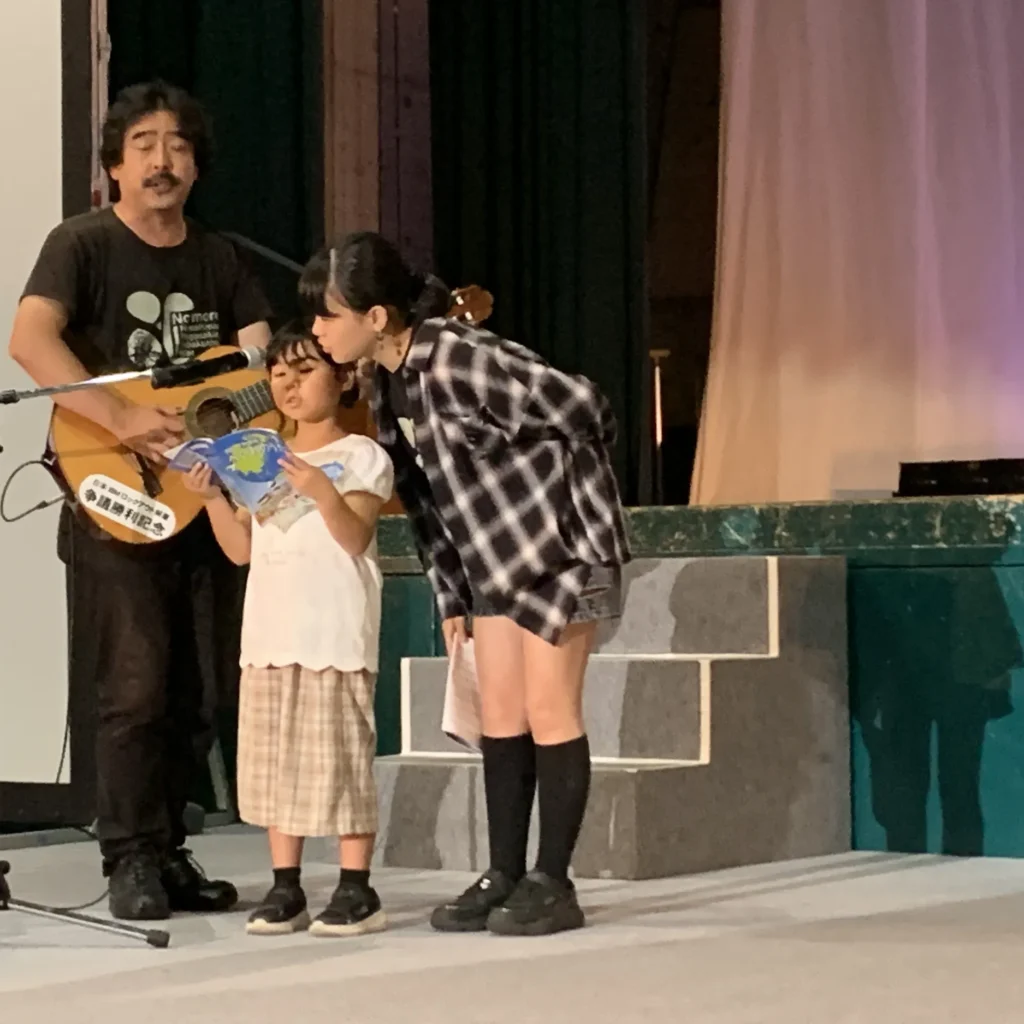
Nihon Hidankyo was founded by then scarred, wounded, and severely marginalized Nagasaki A-bomb youth and Hiroshima Maidens in a meeting following the Second World Conference against A- & H-Bombs in August 1956, 11 years following the A-bombings. I was honored to be invited to this sometimes bittersweet dinner and celebration of their fellowship and achievements, along with Dr. Carlos Umana and Pierre Villard. The formal program began with a high school student reading a children’s book, the testimony of a young man who lost his father and mother in the Bikini H-Bomb test. As he read, I could only imagine the ways in which these veteran Hibakusha were reenvisioning their A-bombing experiences and the poverty and suffering that followed. This was followed by wonderful song and dance performances by Korean Japanese women from Fukuoka. A member of the Nagasaki Council of A-Bomb Survivors recounted Hidankyo’s history, and I noticed that his and other Hibakusha’s eyes teared up as he honored their Nobel Peace Prize achievement. He then decried the efforts to transform Japan into a nuclear weapons state and it becoming a country that can wage war. Statements by various Hibakusha and guests followed, during which I presented September 11 Families for Peaceful Tomorrows greeting to Hidankyo. My good friend Hiroshi Taka gave one of the last and compassionate speeches, during which he noted that Prime Minister Takaishi was the only speaker at the official Hiroshima commemoration not to mention the TPNW. The session closed with talk by Tanaka Terumi, long Hidankyo’s Secretary General and with whom I have worked and toured over the decades, which, given who he is and what he has done, was deeply moving. Among other things, Tanaka-san explained that he is one of the very few surviving Hibakusha who attended Hidankyo’s founding conference, and he noted that Hidankyo was first nominated for the Nobel Peace Prize in 1984,
Tanaka-san is now in his early 90s, and the average age of Hibakusha is now 86. As we celebrated, we could not help but think that in coming years, fewer and fewer of those present will be living and carrying on. Thus, the critical importance of second and third generation carrying the mantle and the for the rest of us to treasure and promote their harrowing testimonies.
A final note. I was surprised by the invitation to join Nihon Hidankyo at the Nobel Peace Prize ceremony. In the course of the World Conference and certainly in this gathering it became increasingly clear that I was invited primarily as an expression of appreciation for the roles I played in nominating them for the Prize four or five times via the American Friends Service Committee and the International Peace Bureau. That and the friendships and collaborations I have had with Hibakusha over the past 42 years, I marvel at how small actions of respect and solidarity can carry so much meaning.
Peace Memorial Park