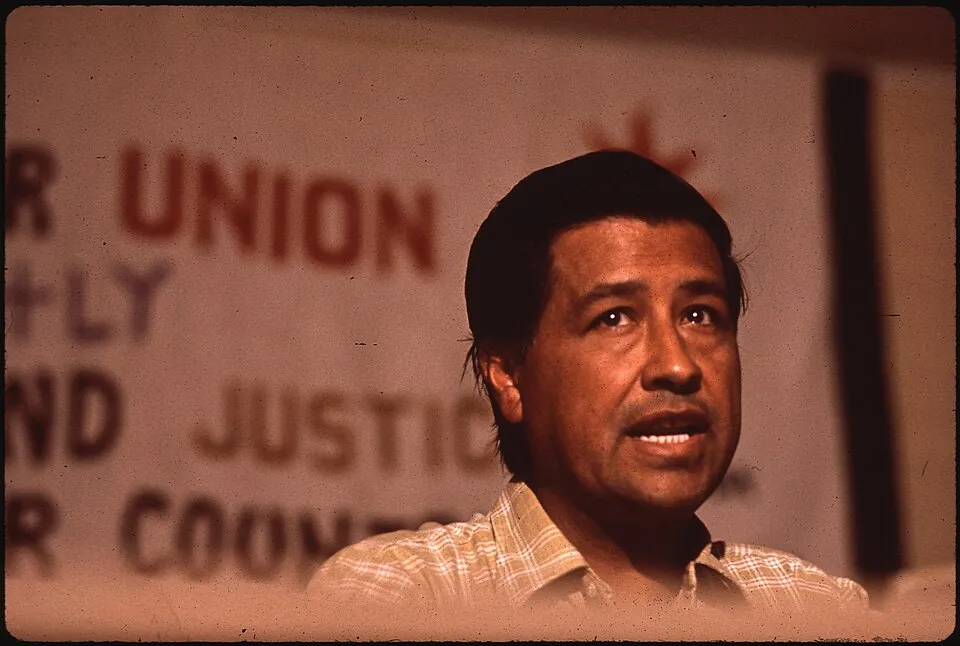
Finally, the shocking word is out. The UFW is distancing itself from Cesar Chavez because he inflicted sexual abuse on women and reportedly raped girls as young as thirteen.
Having had difficult and disillusioning experiences with him in Arizona and later in Europe in the 1970s that revealed his severely compromised moral compass, I am not as surprised as many. I and others suffered the consequences of Chavez’s compromised moral compass. The impacts on our lives certainly were not as great as those now being revealed by the women and girls he raped and otherwise sexually abused. That said, in order to clarify history and to provide a warning about raising false icons this article wanted to be written. Even at the zenith of his leadership, in addition to what we now know about Cesar Chavez’s sexual abuses, his moral compass was compromised in other ways. He was not the iconic leader that so many yearned for.
To be clear, I was and remain a farm workers supporter. In the summer of 1969, I was fired from the Quaker based American Friends Service Committee’s southwest regional program in part for being too closely associated with the UFW. I had supported Gus Gutierrez, the union’s leading Arizona organizer and the friend from whom I first learned about the Mai Lai massacre – with speaking opportunities. At his request, I once hired on as a field worker to trimming grape vines to learn where the scabs had come from. (Only when I was fired was I told that AFSC might at some point want to mediate between the unions and the growers, and that they didn’t want me to compromise that possibility.)
Being an iconoclast is not easy. When my wife Lani and I later attempted to let others know that Chavez was not the unsullied hero they thought he was, many recoiled in cognitive dissonance and perhaps because they did not want to be critical of the iconic Chicano hero. In the mid-1970s, we authored an article for WIN (Workshop in Nonviolence) Magazine that described our disheartening encounters with the celebrated UFW leader. It was the first article whose possible publication was debated by the WIN board. In the end they opted not to publish it, saying that it would be disheartening and divisive. Instead, we published it in Peace News, then a weekly British peace movement newspaper with broad international readership.
A dear friend from my Arizona days recently phoned us to process the disturbing news about Chavez, something I assume that others are wrestling with. There will be challenges to streets named to honor him, exhibits in museums, and even to hagiographic children’s books. So, it seems appropriate to add long held kindling to embers of disappointment.
STRIKE #1
First context: During the Vietnam War, in the late 1960s and early 1970s I played leadership roles in Arizona’s peace and justice movements. Back then, the former territory was anything but the purple state it has become. Before the Phoenix Valley became a corporately rich megacity, it was isolated by hundreds of miles of surrounding deserts and backward. We used to describe it as “the shipping crates they took Los Angeles” out of. Our one-eyed governor, Jack Williams, colloquially known as “One Eyed Jack,” led friends to say that “In the land of the blind, a one-eyed giant is king.” That was in part because to save endangered sheep during a northern Arizona blizzard he once called the weather department to order that it stop a massive snowstorm. Furthermore, unbeknownst to students, in the days following the 1970 National Guard killing students at Kent State University and the nationwide protests that followed, One Eyed Jack secretly ordered Arizona State University campus police to shoot any student who attempted to take down the Stars and Strips. More, to expand the limits on acceptable political discourse and actions, on the anniversary of John Birch’s death, the Arizona Republic – Phoenix area’s monopoly newspaper – annually ran a front-page editorial extolling the late near-Nazi.
Back in that day, at the behest of growers, the Arizona state legislature debated and then passed a law outlawing farmwork organizing. Rather than venture to Arizona to oppose the proposed bill while the law was being debated, Chavez sat it out in California. Then, once it was passed, and without consulting anyone in the state – not even Mr. Guttierez the lead Arizona UFW organizer, Chavez crossed the border, launched a futile campaign for the recall of the governor, ordered Gus to leave Phoenix, deploying him to the far reaches of the state away from the media. and began a fast in a Phoenix Catholic church to boost his demand for a recall election.
Those of us who had been organizing in the state and those at the liberal end of the state’s then stunted Democratic Party knew that Chavez’s campaign would fail. And of course, it did. No base of support had been built for the governor’s ouster. But in the midst of the campaign, Chavez very publicly accepted a $15,000 check (the equivalent today of more than $100,000) from the AFL-CIO for his recall campaign.
There is a related back story from earlier that year, 1972, that is significant for context. During its genocidal Indochina War, the U.S. devastated Southeast Asian nations with anti-personnel cluster bombs. These bombs could not penetrate fortifications, tanks, or homes, but then and now their hundreds of bomblets filled with ball bearings were designed to penetrate skin, drive along people’s bones, and indiscriminately kill or severely wound innocent women, children, and men as well as enemy soldiers. That is why they were later internationally outlawed. Those cluster bombs were manufactured by the Honeywell Corporation (the maker of the thermostats in many of our homes.) In April 1972, Clergy and Laity Concerned About Vietnam War, a nationwide peace organization whose director Rev. Dick Fernandez was on President Nixon’s enemies list, called for a day of informational pickets at Honeywell headquarters across the country.
About fifty of us, including students, community activists, and two Lutheran ministers gathered that day outside the Del Webb Townhouse, one of Phoenix’s fanciest hotels and the site of a Honeywell office. Knowing our constitutional right, we distributed flyers urging Honeywell to get out of the cluster bomb business on the public sidewalk, while to keep ourselves legal we protesters kept moving in something like a circle.
But Honeywell and the Townhouse called the cops. In the tradition of disciplined nonviolence, we decided to have two demonstrators distribute leaflets every 15 minutes. In all, nineteen of us, including the two ministers who had joined a small meeting with Honeywell executives during the protest, were arrested. Because I had some prominence in the Phoenix media, when I was arrested, four policemen held me while a fifth inflicted what we now know as the Eric Garner chokehold. Fortunately, I survived, but with serious damage to my vocal cords.
Life being surreal, despite videotaped evidence that proved our innocence, Judge Richard (Dick) Tracey sentence the Phoenix 19 to six months in jail. Only later did we learn that in May 1970, Dick Tracy had been an FBI agent at Kent State University when student protesters were being shot. Fortunately for us, Jerome Frank, the prominent Phoenix attorney who had represented Ernesto Miranda, later of Miranda rights fame, to the Supreme Court successfully appealed our conviction. We thought that was that.
Not so as we learned several months later! Despite having been informed about this nasty history, Cesar Chavez wanted to end his fast in style, at the Del Webb Townhouse at a cost of those notorious $15,000. Liberal Catholic farmworker supporters met with Chavez to explain why he shouldn’t reinforce and enrich the Townhouse, and that he should end his fast more fittingly in a church. But despite his reputation for simplicity and self-sacrifice, Chavez opted for a big show in the Establishment’s Del Webb Townhouse.
STRIKE #2
I concede that this strike is debatable, perhaps on the corner of the plate, or right at the knees.
After the promulgation Paris Peace Agreement, which we believed would end the Vietnam War, but which in fact merely provided a two-year face saving “decent interval” for U.S. withdrawal, in the spring of 1973 Lani and I joined the staff of the War Resister’s International – a federation of nonviolent organizations – in London. It provided us the extraordinary privilege of working with World War I conscientious objectors, courageous Europeans who had resisted Nazi occupations, future leaders of the 1980s disarmament movements, Israeli pacifists, and even the later murdered PLO representative to Britain.
In late 1975 we moved our office from London to the Maison de Paix in Brussels. One evening, during a European speaking tour, Chavez came there to speak at a public meeting. During the Q & A session, someone asked about land reform – redistribution of vast estates to benefit farmworkers. To the surprise and dismay of many in the audience, Chavez vehemently condemned land reform as communist rather than a policy option that had reduced poverty and raised farmers living standards in many non-communist nations.
STRIKE #3
On our return to Arizona from Europe, my wife and I were invited to dinner in the home of Rev. John Petereson. John had led the second largest Luthern church in the Phoenix Valley, moved to the smaller peace movement associated church at the ASU campus, and was one of the two Phoenix 19 ministers. He was also a deeply engaged UFW activist. That evening John shared an anguished memory.
He explained that while we were in Europe, Chavez returned to Arizona to speak at Arizona State University. And arrangements were made for the union leader to spend the night in the Petersons’ home. That afternoon, John explained, several hard-bitten Chavez bodyguards and their German shepherd dogs unceremoniously explored Peterson’s home. They then asked what Cesar was to be served for supper. Understandably, they dictated that no U.S. produced wine was to be on the table. BUT Cesar was to be served an extremely expensive French wine.
Sixty years later, Delores Huerta, a compromised figure herself (see her history of uncritical support for apartheid Israel) has finally broken her silence.
That’s Strike Four! And we are reminded that all is not what it appears to be.