
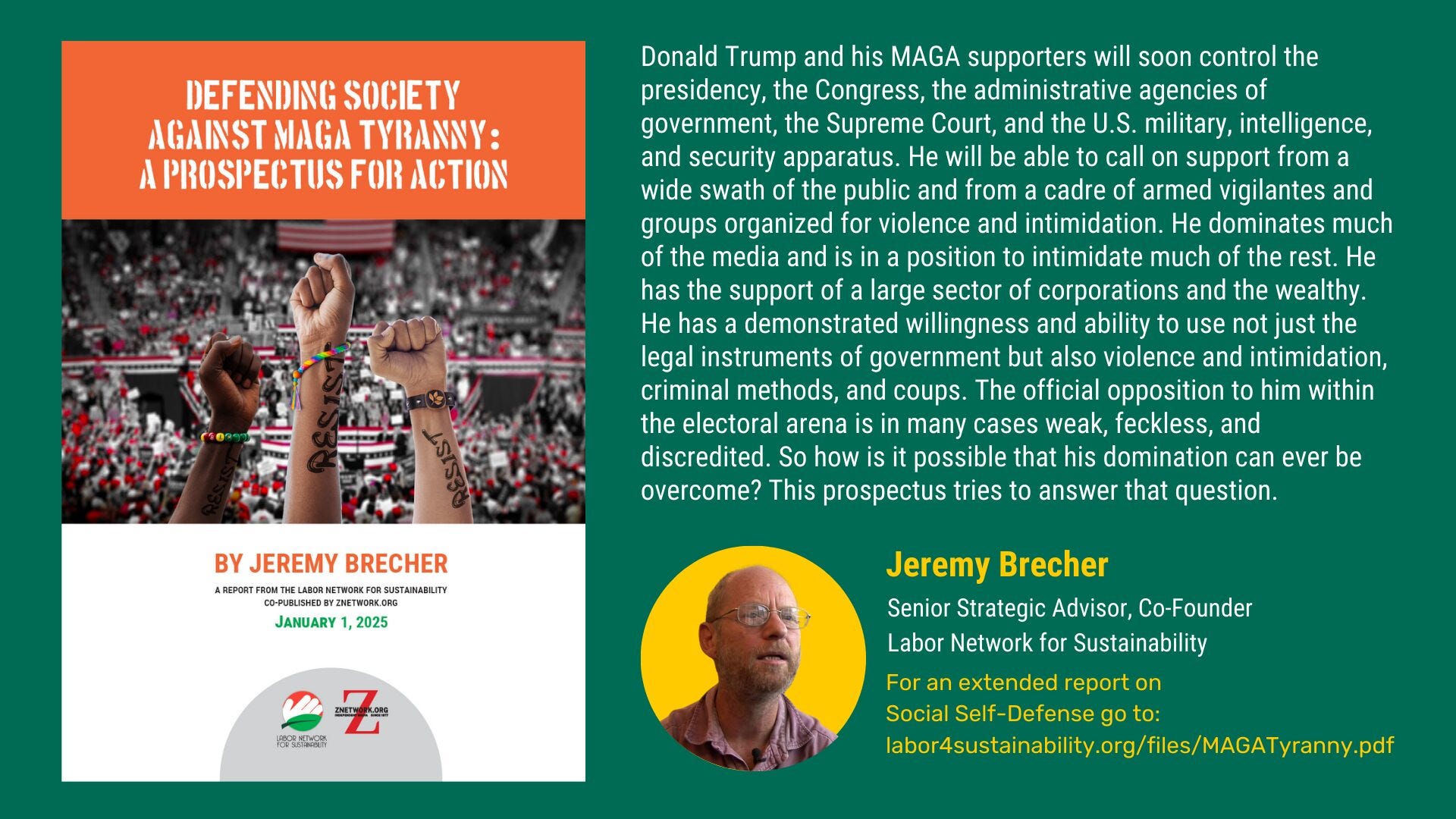
By Jeremy Brecher, Senior Strategic Advisor, LNS Co-Founder
With a few honorable exceptions, Democrats have done little to resist Trump’s juggernaut or to present an alternative program to meet the needs of the American people and reverse the damage Trump and his minions have done to them. Far less have they mobilized their constituents to stand up to Trump’s depredations.
In democratic theory, elections give every person equal weight in deciding political outcomes. Of course, we all know that the reality of actually existing democratic systems barely resembles this. The power of money, oligarchical control of parties, institutional skewing of the playing field, disorganization of subordinate groups, and many forms of racial, gender, and other inequality make our so-called “democracies” highly undemocratic.
That doesn’t mean that elections are meaningless. Rather, they are part of the jostling through which various dominant and subordinate groups negotiate their relationships. They are part of the process that Italian theorist Antonio Gramsci characterized as “hegemony” — the way a ruling class maintains power through the active consent of the public, rather than through military force or physical coercion alone. To exercise hegemony, ruling groups must engage in negotiation and compromise with subordinate groups. Elections and the ecological systems surrounding them are part of the way such compromise is negotiated and implemented.
MAGA’s Strategy for Unending Domination
Trump, MAGA, and their supporters want to ensure that the upcoming mid-term elections are not free and fair, but rather a vehicle to perpetuate their power. Their goal is power that is permanent and uncontested – an equivalent to Hitler’s Thousand-Year Reich.
Trump/Republican attempts to prevent free and fair elections have been going on for years and have escalated since his inauguration. Successful recent actions have included the gutting of the Voting Rights Act and extreme gerrymandering. Key methods include intimidation, confusion, induced hopelessness, physical obstruction, and legal obstruction.
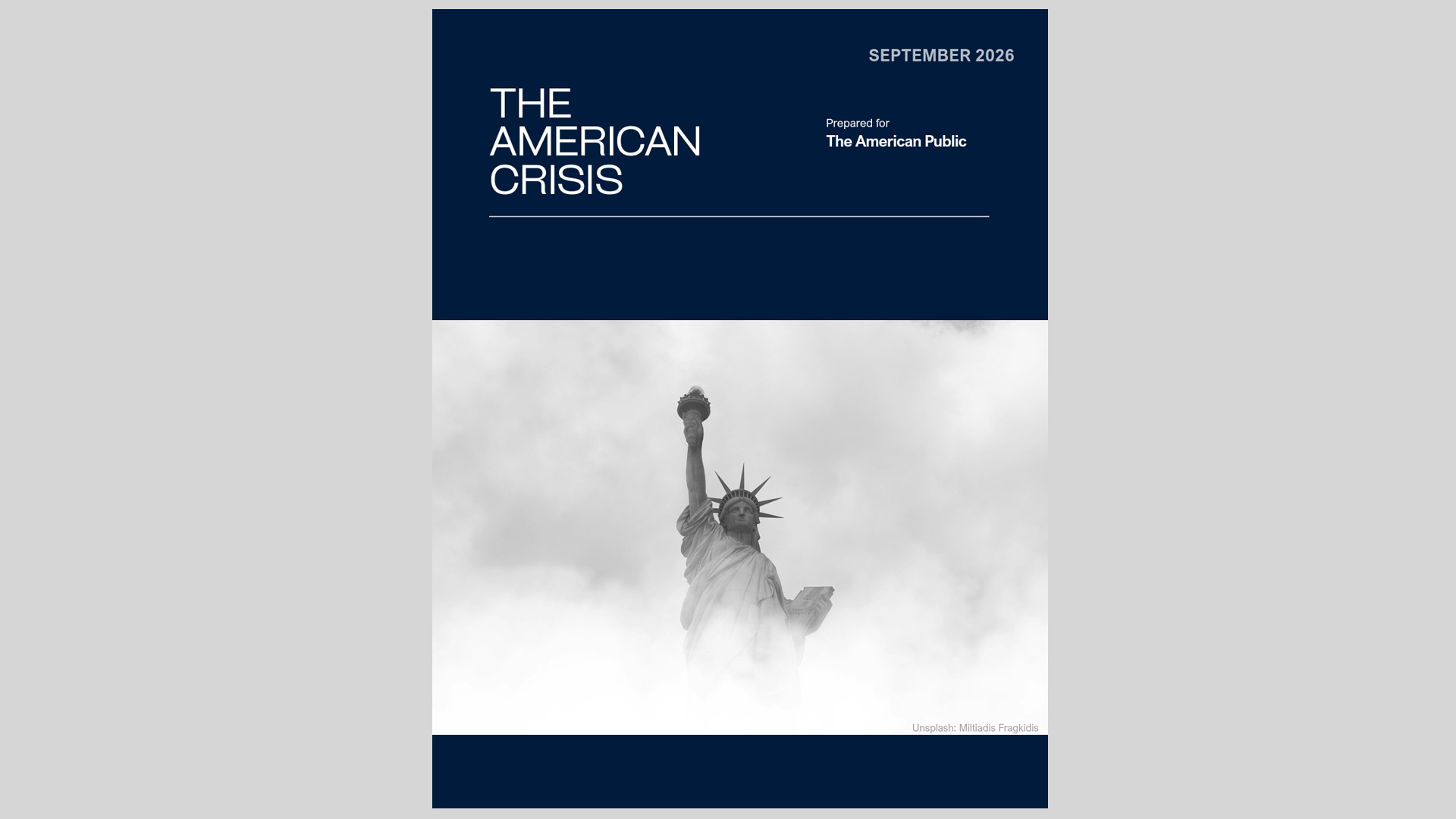
A just-released report called “The American Crisis” by a group of progressive scholars lays out what we can expect going forward:
- In the months and weeks preceding Election Day, we anticipate that election administration roles and responsibilities will be seized from states and cities, or attempts will be made to disrupt, sabotage, or seize their administrative powers. That could include the seizing of voter rolls, the threatening of election officials, and the disruption of vote-by-mail systems.
- In the days leading up to Election Day, and on the day itself, we anticipate a substantial increase of voter intimidation and election disruption tactics, with new deployments of military and paramilitary forces across U.S. cities, elections offices, and polling stations. The National Guard occupation of Washington, DC and the “Memphis Safe Task Force” provide proving grounds for these tactics, including street patrols, traffic stops, warrant service, fugitive apprehension, and court-authorized searches of residences. We expect that “state of emergency” declarations by federal and state officials will increase as well, to enable immediate deployments of military and paramilitary forces, and with fewer restrictions on those deployments.We expect these military and paramilitary intimidation tactics to extend to other non-state or subnational actors, like nonprofit and community-based organizations, unions, and universities, who are involved in monitoring and maintaining free and fair elections. We also anticipate a significant increase in disinformation and misinformation campaigns about polling places, hours, and practices, as well as voter intimidation at polling locations by national, non-state, and paramilitary actors.
- On and after Election Day, we anticipate major obstacles to a democratic transition of local, state, and federal seats and offices. At the state and local level, efforts to impede the post-election transfer of power include interference with vote tabulation and election certification by state and local governments through the use of force or police force or by other means, e.g. by proxy through militias or so-called “sovereign sheriffs” groups. At the federal level, efforts to obstruct or delay the swearing-in of newly elected officials include the removal of the Clerk in the House of Representatives or the refusal of the U.S. Vice President and outgoing House Speaker to swear in newly elected Members of Congress.
Current house speaker Mike Johnson told the September Republican Convention, “We cannot and will not allow them to take the majority in Congress. We’re not gonna do it.” The midterm elections will kick off an ongoing struggle that is likely to continue indefinitely – or at least until the next presidential election.
Social Self-Defense Against Election Subversion
The struggle to defend society against Trump and MAGA is likely to be long and difficult. It will require the self-organization and action of tens of millions of people. It is likely ultimately to require forms of resistance like social strikes that make the country impossible for MAGA to govern.
The struggle around the 2026 mid-term elections is only one piece of the struggle against Trump and for democratization – but it is an important one. It is a struggle not primarily between political parties, but for the protection of society against the MAGA attack. It is part of the broad defense of society against fascism – what I have elsewhere described as “Social Self-Defense”:
The protection of that which makes our life together on earth possible. It includes the protection of the human rights of all people; protection of the conditions of our earth and its climate that make our life possible; the constitutional principle that government must be accountable to law; and global cooperation to provide a secure future for people and planet.
Ending Republican control of the House and, if possible, the Senate will put a brake on the U.S.’s wild ride into fascism – especially if the scale of the turnout and the majority are overwhelming. That will show that a post-election coup is futile. It will also be an important marker on the road to a repudiation of Trump and all he stands for – an indication to all that not only is he vulnerable, but that he is doomed.
Recent polls indicate that such a massive repudiation is within reach. In a September New York Times poll, a majority of voters disapproved of Trump’s handling of every major issue included in the poll: the economy, immigration, tariffs, the war, and the cost of living. Likely voters favored Democratic candidates over Republicans by close to 9 percentage points in their congressional district.
There is a wide swath of groups organized to defend a free and fair election against authoritarian subversion. They represent not one or the other political party, but rather nonpartisan social self-defense. I have described them elsewhere as a “Movement-Based Opposition.”
Many of these groups have initially been focusing on training. For example, Indivisible and the ACLU are collaborating on a series of “Hands Off Our Vote” online webinars. The Freedom Trainers network of nonviolence trainers has run in-depth trainings for thousands, and makes available an 83-page handbook presenting possible scenarios and how to deal with them. The May Day Strong coalition has held 750 “Solidarity Schools” and other actions from late August through mid-September nationwide, bringing together labor organizers and community members. The Voter Protection Advocate Network is building a nationwide cohort of trained and certified voter advocates. According to Deepak Bhargava of the Freedom Together Foundation, “Over one million people have been trained in organizing and nonviolence over the last year.”
Lines of Defense
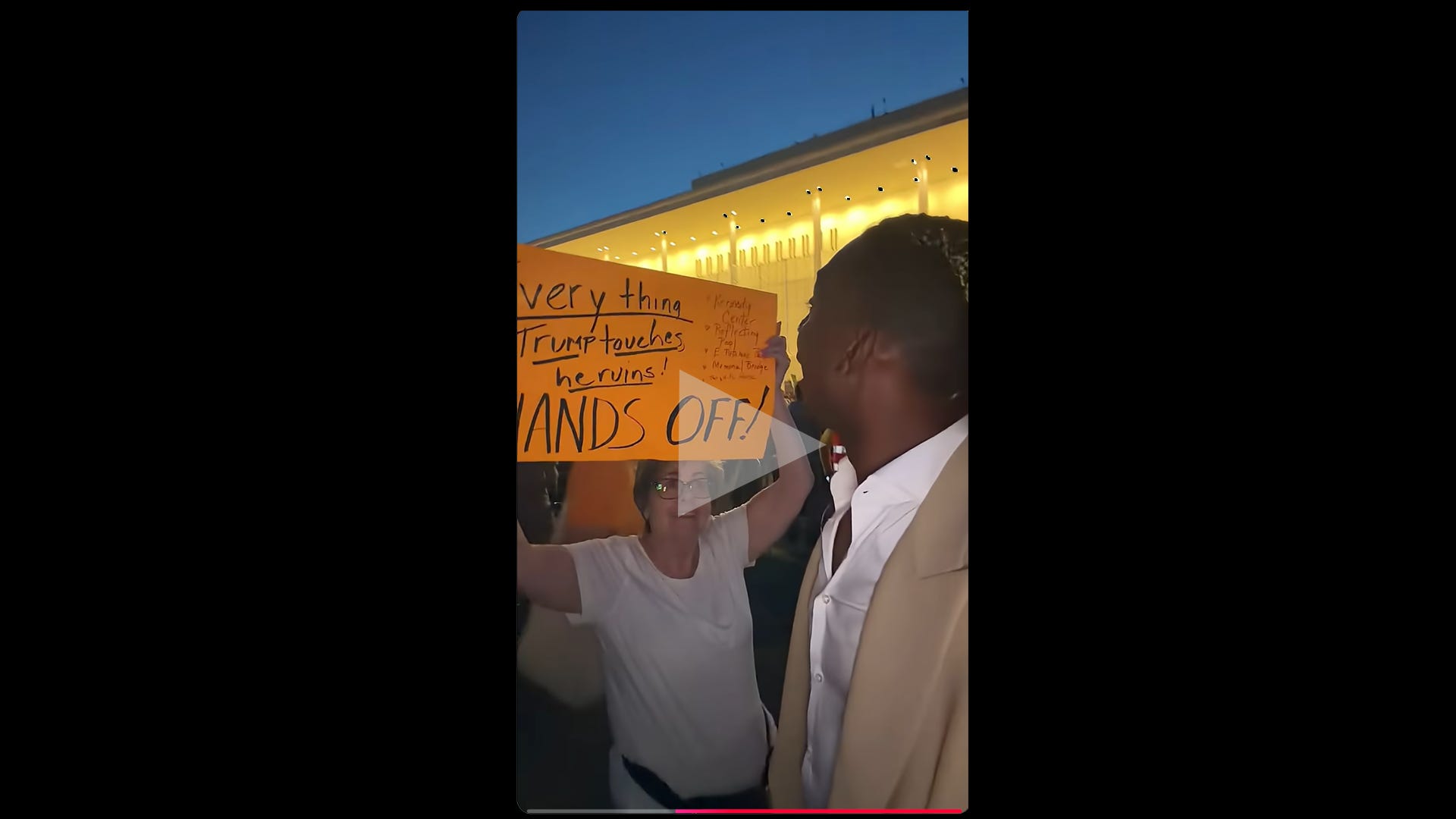
HANDS OFF THE KENNEDY CENTER!!! Youtube short @tevindavisactor
The strategy for defending free and fair elections resembles the military strategy known as “concentric lines of defense.” That entails layered rings designed to “delay, detect, and respond to threats.” Diverse elements of the movement-based opposition are implementing such a strategy. Drawing on a review of their materials and presentations, here are the overlapping rings:
1. Make clear to people why they need to vote against Trump and MAGA. People need to understand that voting in this election is essential for their current and future self-protection and protection of their rights and wellbeing. Some Democrats are doing this quite forcefully, but much of the party is trying to sleaze by with vague promises about “affordability”; many Democrats are even advocating hyperscale data centers, despite the harm they do and their overwhelming unpopularity. Fortunately, civil society groups and the movement-based opposition can take actions that call out Trump’s depredations without waiting for Democrats to lead. Community-based actions against ICE transformed public opinion not only on ICE but on immigration as a whole; the Tesla Takedowns turned Elon Musk into a public pariah.
Such voter-education-through-action can be done locally and on short notice. For example, on September 18th thousands filled streets in Washington, DC and locked down traffic as they walked in a “Hands Around the Kennedy Center” action protesting Trump’s threats to shut or even tear down the iconic Kennedy Center. Indigenous groups have established the Thunderbird Nest resistance camp in Michigan’s Western Upper Peninsula to protest a planned copper sulfide mine which is backed by a $50 million taxpayer subsidy. May Day Strong is organizing “Corporate Campaigns to Reject Trump’s Attack on the Elections”; when an ICE agent shot a DoorDash driver making a delivery, May Day Strong among others called for people to “delete DoorDash” until the company issues a public statement against ICE targeting delivery drivers and calls for Trump’s occupation agents to leave DC.
Local demonstrations and protests can select locations like supermarkets with tariff-induced price increases; corporations supplying the Iran war and Israel; banks financing AI data centers; ICE facilities; agencies involved in voter suppression; and hospitals and clinics whose budgets have been cut. Such actions need not be large: Two dozen people with signs and leaflets at a local supermarket or Social Security office can reach voters directly and through local news coverage and social media. Such actions can connect the dots between the deprivations people are feeling, the machinations of Trump and MAGA, and the power people have to fight back through the vote.
2. Encourage an overwhelming turnout to oppose Trump and MAGA. This includes conventional get-out-the-vote methods, such as phone banking, door-to-door canvassing, registration drives, encouraging people to check that they are registered, providing transportation, and escorting voters. In the era of voter suppression, it also involves countering all kinds of misinformation that is being used to discourage people from voting, ranging from false information about when, where, and how to vote to threats of violence and arrest at polling places. The organizations listed above can provide information to counter such voter suppression.
3. Forestall interference with elections. Most direct vote suppression takes place on election day itself. To forestall this, election protection efforts are focused on encouraging people to vote early. The No Kings Coalition is organizing a massive “No Kings: Vote Early” day of action October 17. It will include block parties, rallies, and walks to the polls.
Voter suppression can include among other things openly biased poll workers, attempts to discourage or block voter registration, incorrect or unevenly applied requests for voter ID, misinformation about where, when, or how to vote, and similar abuses. The abusers may be election officials or MAGA vigilantes.
Hundreds of thousands of “Nonpartisan poll monitors” are being recruited to prevent vote stealing. These volunteers will observe the voting process on election days. They are trained to assist any voters whose votes are not being allowed or counted; to document any infractions and immediately report them to voting officials; and to immediately contact the Election Protection 866-OUR-VOTE hotline or the Election Protection website 866ourvote.org, both staffed by lawyers and law students, for help and guidance.
4. Contest intimidation through rapid response. Community based rapid response networks are a crucial part of election protection. According to the ACLU/Indivisible Election Protection Training 201:
When something happens that risks someone’s vote or risks impacting the election, the single most effective way we can counter it is by responding fast. Half a dozen people outside their local elections office with a few signs just a few hours after something happens are more powerful than a bigger protest that happens later after the news cycle has moved on. So, whether your goal is to have volunteers ready to redirect voters to a correct polling place if they have been misled, if you’re looking to speak out in support of targeted local election workers, if you’re thinking to shine a spotlight on misinformation or bad behavior, what we want to do is be ready before it’s time to actually respond.
Rapid response networks, utilizing mobile communications and trained volunteers, have been central to the protection of American cities against ICE attacks – think Minneapolis. Many immigrant justice rapid response networks are repurposing their organizations for election protection. Immigrant defenders in Wisconsin, for example, are repurposing the Signal infrastructure they built for ICE to arrange for rides to the polls.
Part of the preparation for rapid response is for local groups to reach out in advance to plan coordination with others in their area. They also need to connect in advance with regional and national networks that can provide support in a crisis.
We can assume that Trump/MAGA will attempt to covertly or overtly disrupt our election protection efforts. Community-based rapid response networks are likely to be the most powerful tool for exposing and defeating their machinations – and for publicizing them as one more example of MAGA’s attempt to destroy democracy.
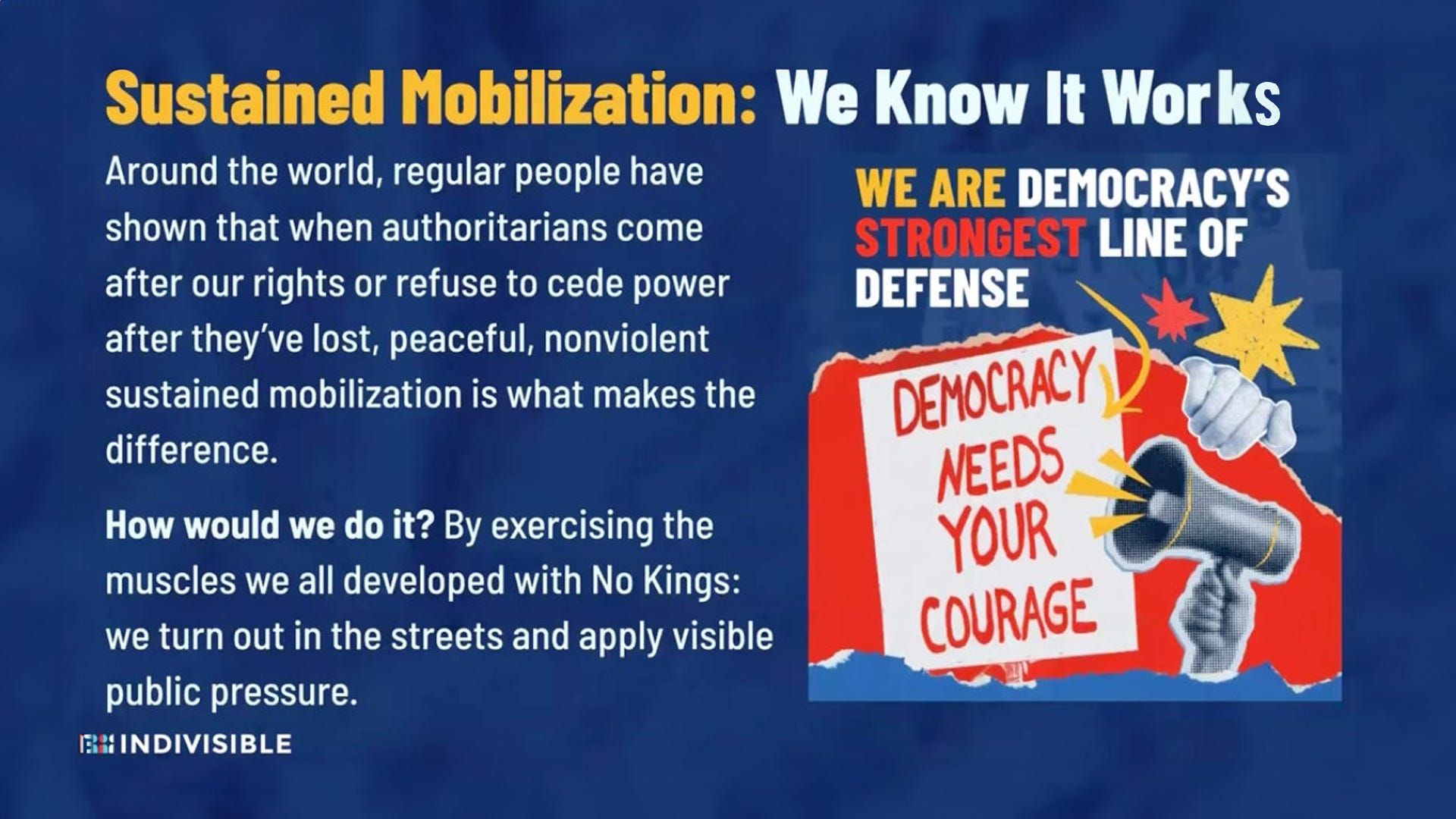
Election Defense 201 training by Hands Off Our Vote
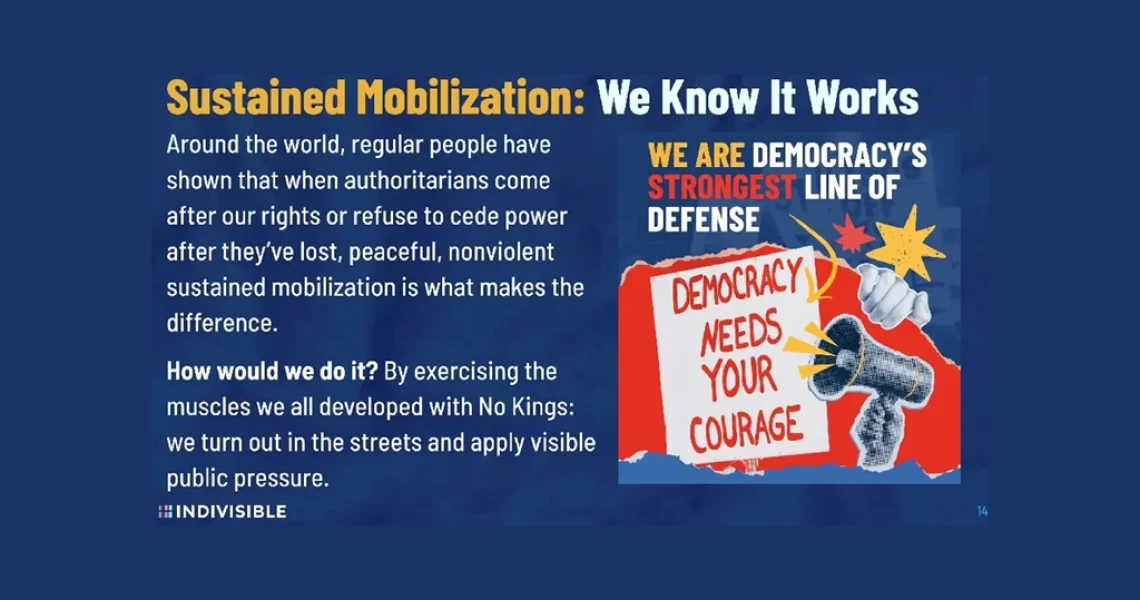
5. Foil electoral coups. We know from the January 6, 2020 insurrection at the U.S. Capitol that Trump and his supporters are likely to stop at nothing to retain power even if they have met a devastating electoral defeat. In such a case, only an unprecedented national popular resistance is likely to stop them. Indivisible refers to this as a “peaceful nonviolent sustained mobilization,” aka a “national freak-out.” Others call for a general strike and other forms of resistance.
Some kind of “all in” action has been widely advocated as a response to another attempted electoral coup, though advocates have been somewhat reticent about specific plans for such action. We now have a model for such sustained mobilization in the resistance to ICE in American cities, highlighted by the “No Work, No School, No Shopping” days of action in Minneapolis. Cliff Albright of Black Voters Matter told the ACLU/Indivisible Election Protection Training 201,
What do we mean by sustained mobilization? We mean a situation where everyday people are maintaining an in-person presence at a significant or symbolic location to demand action until it is met. Like a multi-day protest at someplace like the state capital. This might be the appropriate response if Trump or his administration refuses to concede power.
This wouldn’t be just like other protest moments. It would be a rapid response thing rather than something that’s pre-planned. It can’t just be a 2-hour march on a Saturday and then everybody goes home. Building momentum over time, more and more folks gathering in whatever location, not leaving until every vote is counted and the winners of the election are seated.
Cliff Albright conceded that “there’s a lot of possible unknowns around this.” Writer Micah Sifry identified some pertinent unanswered questions about this strategy: Who will be making the decision to go “all in”? How will demands be conveyed to the relevant authorities? If the Trump administration refuses to concede, then what? I have discussed at length the possibilities, problems, and strategies for such action in my report Social Strikes: Can General Strikes, Mass Strikes, and People Power Uprisings Provide a Last Defense Against MAGA Tyranny? It addresses in detail such questions as bases of power, organization, decision-making, negotiations, strategy, and tactics for a “people power” response to an attempted Trump coup.
6. Lay the groundwork for democratization. Long before Trump and MAGA, the U.S. and its electoral system were far from fully democratic. Trump’s efforts to establish tyranny have aimed to demolish their remaining democratic elements– with considerable success. Social self-defense requires more than just reestablishing the marginally democratic system that preceded Trump’s juggernaut. It requires accountability for those who have tried to destroy our human, democratic, and environmental rights. It requires structural change that reinforces the democratic aspects of our political system and that eliminates the undemocratic and authoritarian ones. That requires a process of democratization that builds popular power from the grassroots. The election protection movement can provide a propitious starting point for that democratization from below.
Note: If you are not already connected to local election protection efforts, you can go to Ground Control to find volunteer opportunities near you.